How to Become a Veterinary Technician: Step-by-Step Guide
Most states gate this work behind an accredited program plus a credentialing exam, so the order you tackle them in decides when you can actually be hired.
Becoming a veterinary technician usually means finishing a two-year associate's degree in veterinary technology, passing a credentialing exam, and then being registered, licensed or certified by your state board. The U.S. Bureau of Labor Statistics (2025) reports that technicians typically need a 2-year associate's degree, while veterinary technologists usually need a 4-year bachelor's degree, and that both typically must take a credentialing exam and become registered, licensed or certified depending on state requirements.
The exam most states use is the Veterinary Technician National Examination (VTNE), owned by the American Association of Veterinary State Boards (AAVSB). The AAVSB itself does not license, certify or register anyone — that is done by state and provincial boards, so your state's rules decide which programs and routes count.
What the Job Actually Involves
Most of the work happens in private clinics and animal hospitals, though veterinary technologists and technicians also work in laboratories, colleges and universities, and humane societies (U.S. Bureau of Labor Statistics).
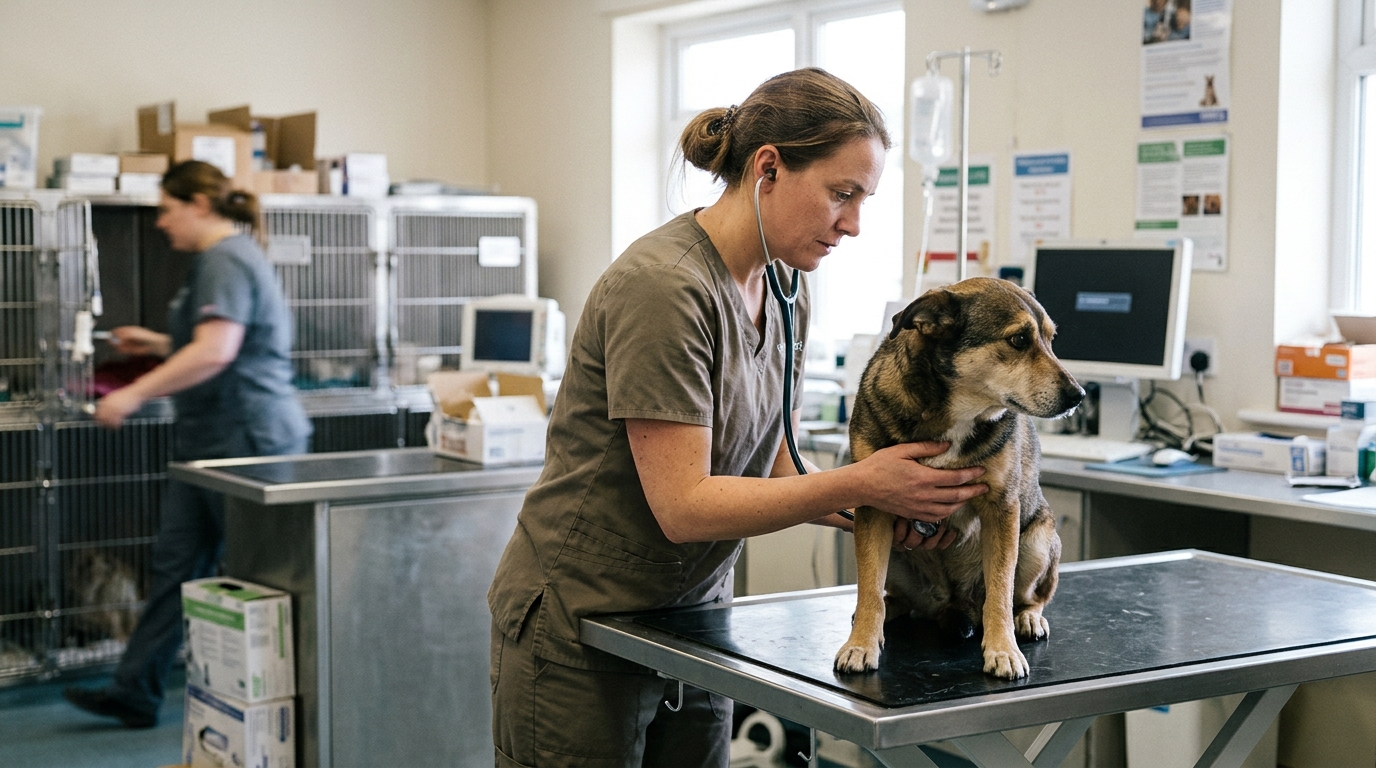
A representative day in a small-animal practice runs roughly like this:
- Morning: review the day's appointments and surgical list in the clinic's practice-management software, pull patient records, and collect case histories from owners at check-in (U.S. Bureau of Labor Statistics, 2025).
- Restrain animals during physical exams and take vital signs, then observe animal behavior and condition and flag changes for the veterinarian (U.S. Bureau of Labor Statistics, 2025).
- Run lab work in-house: urinalysis, complete blood counts, and tests on blood, urine and feces using a centrifuge, refractometer, microscope and benchtop analyzers (U.S. Bureau of Labor Statistics, 2025; O*NET OnLine, 2026).
- Take x-rays, including positioning and restraint, and wear dosimetry badges and lead gowns (U.S. Bureau of Labor Statistics, 2025).
- Surgery block: prepare animals and instruments for surgery — clipping and scrubbing surgical sites, packing and autoclaving instrument sets, placing IV catheters — then administer anesthesia under the veterinarian's direction and monitor responses using an anesthetic machine and vaporizer, endotracheal tubes, pulse oximetry and ECG (U.S. Bureau of Labor Statistics, 2025; O*NET OnLine, 2026).
- Recovery: care for animals recovering from surgery, administer medications, vaccines and treatments prescribed by a veterinarian, and provide nursing care or emergency first aid (U.S. Bureau of Labor Statistics, 2025; O*NET OnLine, 2026).
- Maintain the controlled drug inventory and log books, which means counting and reconciling every dose (O*NET OnLine, 2026).
- Also routine: bathing, clipping and grooming animals, cleaning kennels and cages, and disinfecting tables and instruments between patients (U.S. Bureau of Labor Statistics, 2025).
Schedules vary by setting. General practices often run weekday shifts with rotating Saturdays. Emergency and 24-hour referral hospitals run around the clock, commonly on longer shifts covering nights, weekends and holidays, sometimes with on-call rotations. Research laboratories and university facilities usually run closer to standard business hours but include weekend animal-care coverage. The job is physical: lifting and holding patients, standing for most of the shift, and exposure to bites, scratches, anesthetic gases and radiation. Employment in the occupation is projected by the U.S. Bureau of Labor Statistics (2025) for 2025–35, and O*NET OnLine publishes national employment projections as well — check both for the current outlook before you commit.
Step-by-Step Path to Entry
- Finish high school or earn a GED. Programs in veterinary technology require it for admission. Take biology, chemistry and algebra if you still can — they are common prerequisites. Duration: as long as your schooling takes.
- Confirm your state's rules first, before you enrol. Each state regulates veterinary technologists and technicians differently, and most require you to pass an exam (U.S. Bureau of Labor Statistics, 2025). Your state veterinary board publishes which programs it accepts. Washington State's Department of Health, for example, accepts graduation from an AVMA-accredited veterinary technology school, a CVMA-accredited school, a non-accredited 2-year program plus 36 months of supervised full-time experience, or licensure in another state plus 36 months of experience — and requires the VTNE in every case. Other states differ. Duration: a few hours. Cost: none.
- Enrol in and complete a veterinary technology program. A technician associate's degree takes about 2 years; a technologist bachelor's degree takes about 4 years (U.S. Bureau of Labor Statistics, 2025). Tuition varies widely by school type and residency status — ask the registrar for the published per-credit tuition plus fees for books, scrubs and liability insurance, and get the total in writing before you sign.
- Complete the program's clinical hours. Externships and preceptorships are built into accredited programs and are where you first do restraint, venipuncture and anesthetic monitoring on live patients. The U.S. Bureau of Labor Statistics (2025) lists on-the-job training as part of entering the occupation. This step cannot be skipped or taken out of order — it is graded coursework.
- Apply for the VTNE through the AAVSB. The VTNE is owned by the AAVSB, and eligibility runs through the AAVSB's published pathway. There is an application fee set by the AAVSB; check the AAVSB's current fee schedule, as it changes. The AAVSB publishes the exam's structure and the passing requirement in its candidate handbook — read that before you book a testing window. Many candidates apply in their final term so they can test shortly after graduating.
- Apply to your state board for licensure, registration or certification. The AAVSB does not license, certify or register veterinary technicians; state and provincial boards do that (AAVSB candidate handbook, as reproduced by the North Dakota Board of Veterinary Medical Examiners, 2013). Expect transcripts, exam score transfer, an application fee and, in most states, a criminal background check. Duration: typically several weeks for processing, but it varies by board.
- Apply for jobs. Steps 6 and 7 can overlap — many clinics hire graduates as assistants while a credential application is pending, if state law permits it in your state. Bring a skills list: species handled, catheter placements, anesthetic cases monitored, radiographic views taken.
- Keep the credential current. Most state boards require continuing education and periodic renewal. Your board publishes the hour requirement and the renewal cycle.
Education and Certification Options Compared
| Path | Credential earned | Typical duration | Typical cost | Satisfies state licensing? |
|---|---|---|---|---|
| AVMA-accredited associate degree in veterinary technology | Associate degree (veterinary technician) | About 2 years (U.S. Bureau of Labor Statistics, 2025) | Varies by school and residency; request published tuition and fees | Accepted as the education requirement in states such as Washington, paired with a VTNE pass (Washington State Department of Health) |
| AVMA-accredited bachelor's degree in veterinary technology | Bachelor's degree (veterinary technologist) | About 4 years (U.S. Bureau of Labor Statistics, 2025) | Varies by institution; request published tuition and fees | Same education basis as above in Washington; confirm with your own state board |
| CVMA-accredited veterinary technology school | Diploma from a CVMA-accredited school | About 2 years | Varies by school | Accepted by Washington State Department of Health, with the VTNE required |
| Non-accredited 2-year program plus supervised experience | Program certificate plus 36 months supervised full-time experience | 2 years of study plus 36 months of work | Varies by program plus paid working time | Accepted in Washington with the VTNE; many states do not offer this route |
| Endorsement from another state | Existing out-of-state license plus 36 months experience | 36 months of experience after initial licensure | State application fee | Accepted in Washington with the VTNE; terms differ state to state |
| VTNE (American Association of Veterinary State Boards) | Passing exam result | One testing appointment | AAVSB application fee — check the AAVSB's current fee | Required by most states; the AAVSB does not itself license or register anyone |
The measurable difference between the two main routes is time: the associate path takes about 2 years versus about 4 years for the bachelor's, and the bachelor's is the degree normally tied to technologist roles (U.S. Bureau of Labor Statistics, 2025). The non-accredited route in Washington costs 36 additional months of supervised full-time work before you are eligible.
Requirements Checklist Before You Apply
- Hold a high school diploma or GED.
- Have graduated from a veterinary technology program your state board accepts — AVMA-accredited, CVMA-accredited, or another route your board names in writing.
- Have an official transcript ready to send directly from the school to the board.
- Have submitted a VTNE application to the AAVSB and paid the current application fee listed on the AAVSB's fee schedule.
- Hold a passing VTNE result, reported under the passing requirement published by the AAVSB.
- Have filed a license, registration or certification application with your state veterinary board, since the AAVSB does not license, certify or register technicians.
- Have completed any criminal background check or fingerprinting your state board requires, and disclosed anything the application asks about.
- Confirm you are legally eligible to work in the United States and can supply the documents an employer's onboarding requires.
- Be able to lift and restrain patients and stand for a full shift; many employers state a specific lifting requirement in the job posting.
- Have documented rabies pre-exposure vaccination or a current titer if the employer or facility requires it; laboratory and shelter settings often do.
- Have a written skills list: species handled, venipuncture, IV catheter placement, anesthetic monitoring, radiographic positioning, in-house lab tests run.
- Have two or three clinical references, ideally supervising veterinarians or credentialed technicians from your externship.
- Hold a valid driver's license if you are applying to mobile, large-animal or shelter-transport roles.
Frequently asked questions
How long does it take to become a veterinary technician?
The usual route is a 2-year associate's degree in veterinary technology, which the U.S. Bureau of Labor Statistics (2025) lists as typical entry-level education for technicians. Add time for the VTNE application and your state board's processing after graduation. Veterinary technologist roles usually require a 4-year bachelor's degree (U.S. Bureau of Labor Statistics, 2025).
Do I need a license in every state?
Each state regulates the occupation differently, but most require technologists and technicians to pass an exam, and both groups typically must become registered, licensed or certified depending on state requirements (U.S. Bureau of Labor Statistics, 2025). The AAVSB owns the VTNE but does not license, certify or register anyone — check your own state veterinary board for the title used and the rules that apply.
What does the VTNE cost and who runs it?
The Veterinary Technician National Examination is owned by the American Association of Veterinary State Boards, which sets the application fee and publishes the exam's structure and passing requirement. Fees change, so check the AAVSB's current fee schedule and candidate handbook rather than relying on a figure you read elsewhere. Budget separately for your state board's own application fee.
Can I enter without an accredited degree?
In some states, yes, with substituted experience. Washington State's Department of Health accepts a non-accredited 2-year program plus 36 months of supervised full-time experience, or licensure in another state plus 36 months of experience — and still requires a VTNE pass. Many states do not offer this route. Confirm with your state board before enrolling anywhere non-accredited.
What's the difference between a veterinary technician and a technologist?
Education length, mainly. Technicians usually need a 2-year associate's degree; technologists usually need a 4-year bachelor's degree (U.S. Bureau of Labor Statistics, 2025). Both typically take a credentialing exam and become registered, licensed or certified according to state requirements. Duties overlap heavily, and technologists more often appear in laboratory, university and research settings.
Where should I check current pay?
Use the U.S. Bureau of Labor Statistics Occupational Outlook Handbook, which publishes a 2025 median pay figure for veterinary technologists and technicians, and O*NET OnLine, which publishes national wage data (2024). Both let you see state-level variation. Pay is usually an hourly wage, with shift differentials common in 24-hour emergency hospitals and overtime for shifts beyond the scheduled length.
Sources
- U.S. Bureau of Labor Statistics — Veterinary Technologists and Technicians : Occupational Outlook Handbook (2025)
- U.S. Bureau of Labor Statistics — Veterinary Technologists and Technicians : Occupational Outlook Handbook