How to Become a Solar Panel Installer Without a Degree
Solar crews hire on safety cards, documented training hours and verifiable install photos — not diplomas; here is which credential opens which door.
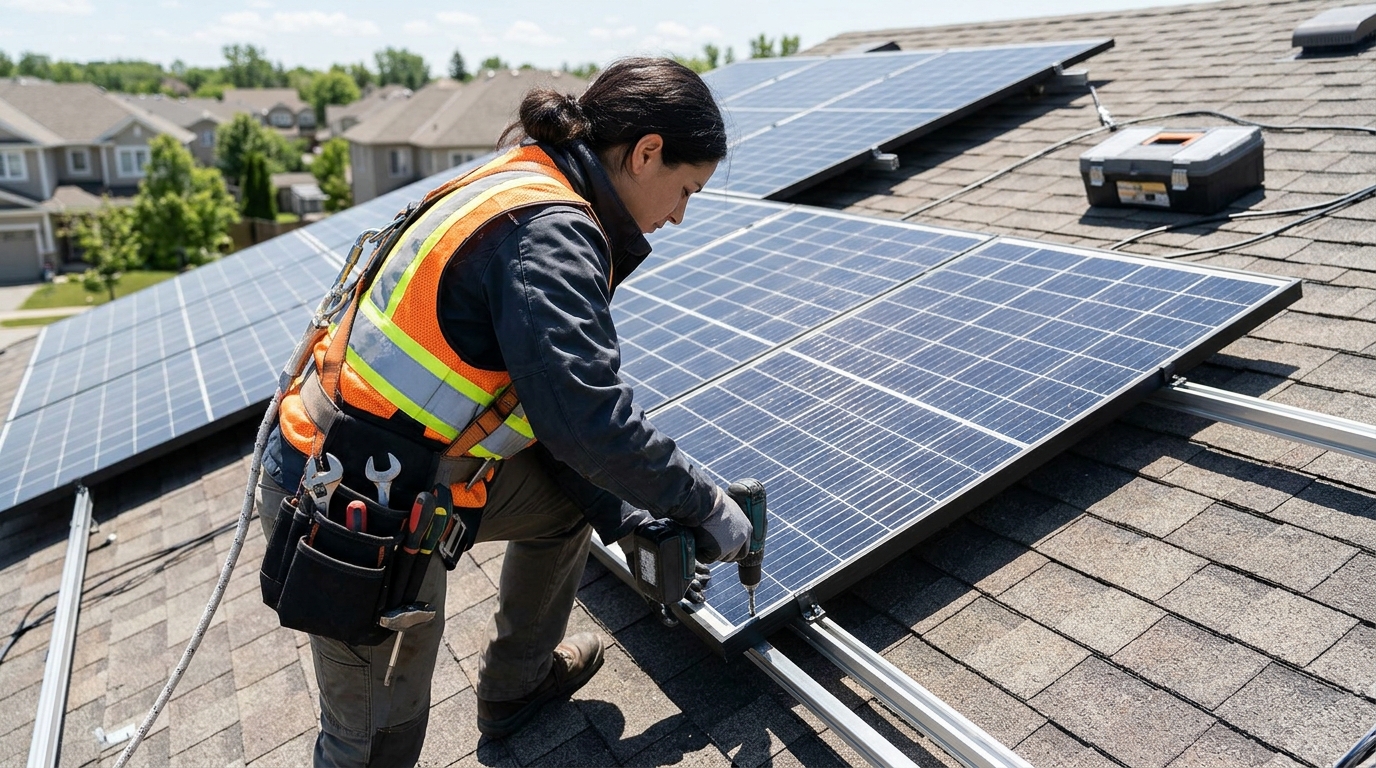
Solar photovoltaic installation is one of the few construction trades where a high school diploma or GED, an OSHA 10-Hour Construction card and a clean driving record are enough to be considered for a ground-crew or installer-helper job. Employers substitute documented safety training, verifiable hands-on hours and entry credentials such as the NABCEP PV Associate for formal education, and they train the rest on site.
The realistic minimum from standing start to a first paid installer job is about 4 to 10 weeks if you focus on safety cards and applications. Anything involving wiring, conduit or the AC side of a system runs through state electrical licensing, which varies by state and usually means an apprenticeship measured in years, not weeks.
What Employers Accept Instead of a Degree
No part of residential or commercial solar installation requires a college degree. What contractors do require is proof you can be put on a roof legally and insured, and that comes from specific documents.
- OSHA 10-Hour Construction card, issued through the OSHA Outreach Training Program by an authorized trainer. Nearly every solar EPC (engineering, procurement and construction) contractor and residential installer asks for this or will send you to get it in your first week. OSHA 30-Hour is expected for leads and foremen. Online courses typically run $25-$100.
- NABCEP PV Associate, issued by the North American Board of Certified Energy Practitioners. This is the entry credential: it requires completion of an approved training program of at least 40 hours of photovoltaic instruction, not prior field experience, and it is the single most common way a no-degree candidate signals competence. Exam fees have generally sat in the $100-$250 range plus the cost of the course — confirm the current fee directly with NABCEP.
- NABCEP PV Installation Professional (PVIP), the journey-level credential. It requires documented installation experience and a decision-making role on a stated number of systems, so it is a 2-to-4-year goal, not an entry ticket. Larger EPCs and utility-scale subcontractors use it to qualify crew leads, and some rebate programs and state incentive rules require a PVIP on the job.
- A state electrical license or registered apprenticeship indenture. Who may terminate conductors, pull conduit and make the AC interconnection is set by state law. Several states also have a separate solar or photovoltaic contractor classification. Check your state electrical board or contractor licensing board before assuming an unlicensed worker can do the electrical scope.
- Documented experience and a portfolio. Roofers, framers, HVAC techs and electricians' helpers move into solar on the strength of 1-2 years of documented construction work plus photos of completed jobs. For career changers, training-lab photos of racking layout, flashing, module mounting and torque checks serve the same purpose.
- Military electrical and construction trades — Navy Construction Electrician (Seabees), Army 12R Interior Electrician, Air Force electrical systems specialties — are accepted by many contractors in place of civilian experience, and hours may count toward apprenticeship credit depending on the program sponsor.
Two more items are near-universal and have nothing to do with schooling: a valid driver's license with a clean motor vehicle record, because crews travel in company trucks, and the physical ability to carry modules, climb ladders and work on pitched roofs in heat.
Compare Your Fastest Entry Options
| Path | Typical cost | Typical duration | What it gets you |
|---|---|---|---|
| Direct hire as ground crew / installer helper with OSHA 10 only | $25-$100 for the OSHA card | 4-10 weeks including applications and onboarding | Paid work immediately; racking, module handling, materials staging. No electrical scope. |
| PV certificate course (community college PV program or a national training provider such as Solar Energy International) plus NABCEP PV Associate exam | roughly $500-$3,000 for the course, plus the NABCEP exam fee | 40 hours of instruction over 1-6 weeks; exam scheduled after | A named credential plus lab photos; moves you past helper status faster and is recognized nationally |
| Registered Apprenticeship (search apprenticeship.gov for solar photovoltaic installer or electrician programs; electrical apprenticeships are commonly sponsored by joint labor-management training committees) | no tuition in most sponsored programs; you are paid from day one, with some books and tool costs | 1-2 years for a solar installer program; about 4-5 years for an electrical apprenticeship | Paid training, documented on-the-job hours, and the only clean route to a state electrical license |
| Military electrical or construction trade | no tuition; service obligation of 4+ years | 4+ years including initial technical training | Transferable electrical experience, safety discipline, and possible apprenticeship credit |
The measurable differences that matter:
- Speed. OSHA-card-only entry is the fastest by a wide margin — weeks, against months for a certificate and years for an apprenticeship.
- Cost direction. Apprenticeships and military training pay you; certificate programs charge you $500-$3,000 before you earn anything.
- Ceiling. Only the apprenticeship route reliably leads to a state electrical license, which is what separates an installer from a licensed electrician doing interconnections and service work.
Avoid any program that will not tell you, in writing, whether its curriculum meets NABCEP's approved-training-hours requirement for the PV Associate exam and whether it includes hands-on roof or racking labs. A classroom-only course leaves you with no photos to show.
Step-by-Step: Fastest Path to a First Job
Realistic minimum: 4 to 10 weeks from start to first paycheck on a crew, assuming you already have a diploma or GED and a driver's license.
- Confirm your baseline documents (week 1). Diploma or GED, a valid driver's license, and documents for I-9 employment verification. Pull your own motor vehicle record from your state DMV if you are unsure what it shows; fees are usually under $20. Many installers will not hire a driver with recent major violations.
- Complete OSHA 10-Hour Construction (week 1, $25-$100). Use an OSHA Outreach Training Program authorized provider. Keep the card and the card number — recruiters ask for it.
- Add the short safety cards employers screen on (weeks 1-2, roughly $50-$250 combined). Fall protection awareness, ladder safety, first aid/CPR, and a powered industrial truck or aerial lift card if you want warehouse or utility-scale work.
- Decide between applying now or taking a PV course (week 2). If you need income immediately, start applying. If you can fund 40 hours of instruction, enrol in a community college PV certificate or a recognised national PV training provider ($500-$3,000) and complete the hands-on lab module.
- Sit the NABCEP PV Associate exam (weeks 4-8). Register through NABCEP, submit your training documentation, and schedule at a proctored test centre. Budget the current exam fee — historically in the $100-$250 band — and confirm it with NABCEP before you plan.
- Check your state's rules before you promise any electrical scope (varies by state). Contact your state electrical board or contractor licensing board and ask two questions: can an unlicensed worker perform PV mechanical and DC work under supervision, and does the state have a separate solar contractor classification? The answers differ state to state and change.
- Assemble one page of evidence (week 3 onward). Card numbers, course transcript, 5-10 labelled photos of racking, flashing, module mounting or conduit runs, and three references with working phone numbers.
- Apply in three directions at once (weeks 3-10). Residential installers hiring installer helpers; EPC contractors and their subcontractors for commercial roofs; staffing firms that crew utility-scale solar farms, which often hire in waves and may require travel for 2-6 month stints.
- Start logging hours from day one. Record addresses, system sizes in kW, your role and dates. That log is what qualifies you later for NABCEP PVIP or for apprenticeship credit.
What You'll Still Need to Prove
Every item here is binary — you either have the document or you do not. Have them scanned and ready before you apply.
- High school diploma or GED certificate.
- OSHA 10-Hour Construction card, with the card number visible.
- Valid driver's license and a motor vehicle record you have actually read.
- Right-to-work documents for I-9 verification.
- NABCEP PV Associate certificate and ID number, if you took that route; otherwise a transcript showing completed PV training hours.
- Fall protection and ladder safety training records; first aid/CPR card with expiry date.
- Aerial lift or forklift operator card, where the employer runs that equipment.
- 5-10 captioned photos of work you have physically done: racking rails, flashings, module placement, torque marks, conduit, or labelled lab builds.
- Three references with current phone numbers — a trainer, a former supervisor, and someone who has seen you work at height.
- Written confirmation that you can lift and carry a solar module repeatedly, climb ladders and work on pitched roofs; expect a physical and a drug screen.
- Your state electrical or solar contractor licensing status, if the role includes any electrical scope. Have the license or apprentice registration number, or a clear statement that you work under a licensed supervisor.
- A basic hand-tool kit and work boots, if the posting says tools required.
For current pay structure in your area — hourly wage, overtime, per-diem on travel crews and piece-rate or bonus arrangements used by some residential companies — look up Solar Photovoltaic Installers (SOC 47-2231) in the BLS Occupational Employment and Wage Statistics and your state workforce agency's wage data, and ask each employer directly how overtime and travel pay work.
Frequently asked questions
Does skipping a degree limit how far I can go in solar?
Not by itself — but an unlicensed installer's ceiling is crew lead or site supervisor. Moving into electrical work, service, commissioning or running your own contracting business generally requires a state electrical or solar contractor license, reached through a registered apprenticeship of roughly 4-5 years and a state exam. NABCEP PV Installation Professional, based on documented install experience, is the other main advancement credential. Check your state licensing board for its specific route.
Can I get hired with no experience at all?
Yes, for ground-crew and installer-helper roles. Employers substitute an OSHA 10-Hour Construction card, a clean driving record, proof you can carry modules and climb ladders, and three references. Adding 40 hours of approved PV training and the NABCEP PV Associate credential shortens the time spent as a helper, because it gives the employer a documented training record instead of a promise.
How long until I can work on the electrical side?
Plan on years, not weeks. An electrical apprenticeship typically runs 4-5 years and combines paid on-the-job hours with classroom instruction, ending in a state journeyman exam. Some states allow registered apprentices to do DC-side and mechanical work under a licensed supervisor from early on. Your state electrical board sets the rules, and they differ state to state.
Is the NABCEP PV Associate worth the cost?
It is the only entry-level PV credential most US employers recognise by name, and it requires 40+ hours of approved training rather than field experience. Total outlay is roughly $600-$3,250 — course plus exam fee. If you are already being hired as a helper, many workers wait and take it later; if you are a career changer with no construction history, it is the clearest proof you can offer.
Do utility-scale solar jobs have different requirements?
Often fewer entry requirements but more travel. Staffing firms crewing solar farms commonly hire on an OSHA 10 card, a driver's license and the ability to pass a physical, then deploy in 2-6 month stints with per-diem. Site-specific safety orientation, and sometimes an aerial lift or powered industrial truck card, is added on arrival.