How to Become a Pharmacy Technician: Step-by-Step Guide
What the work looks like shift by shift, which certifying body issues the CPhT, and why your state board decides the order you do things in.
Becoming a pharmacy technician usually means finishing high school, completing training (either through an employer or a formal program), meeting your state board of pharmacy's registration rules, and sitting a certification exam such as the Pharmacy Technician Certification Exam (PTCE) from the Pharmacy Technician Certification Board (PTCB) or the ExCPT from the National Healthcareer Association (NHA). The U.S. Bureau of Labor Statistics (2025) lists a high school diploma or equivalent as the typical entry-level education, with on-the-job training as part of the usual route.
The variable part is your state. Some states require registration or licensure and a set number of training hours before you can work; others leave more to the employer. Check your state board of pharmacy before you pay for anything.
What the Job Actually Involves
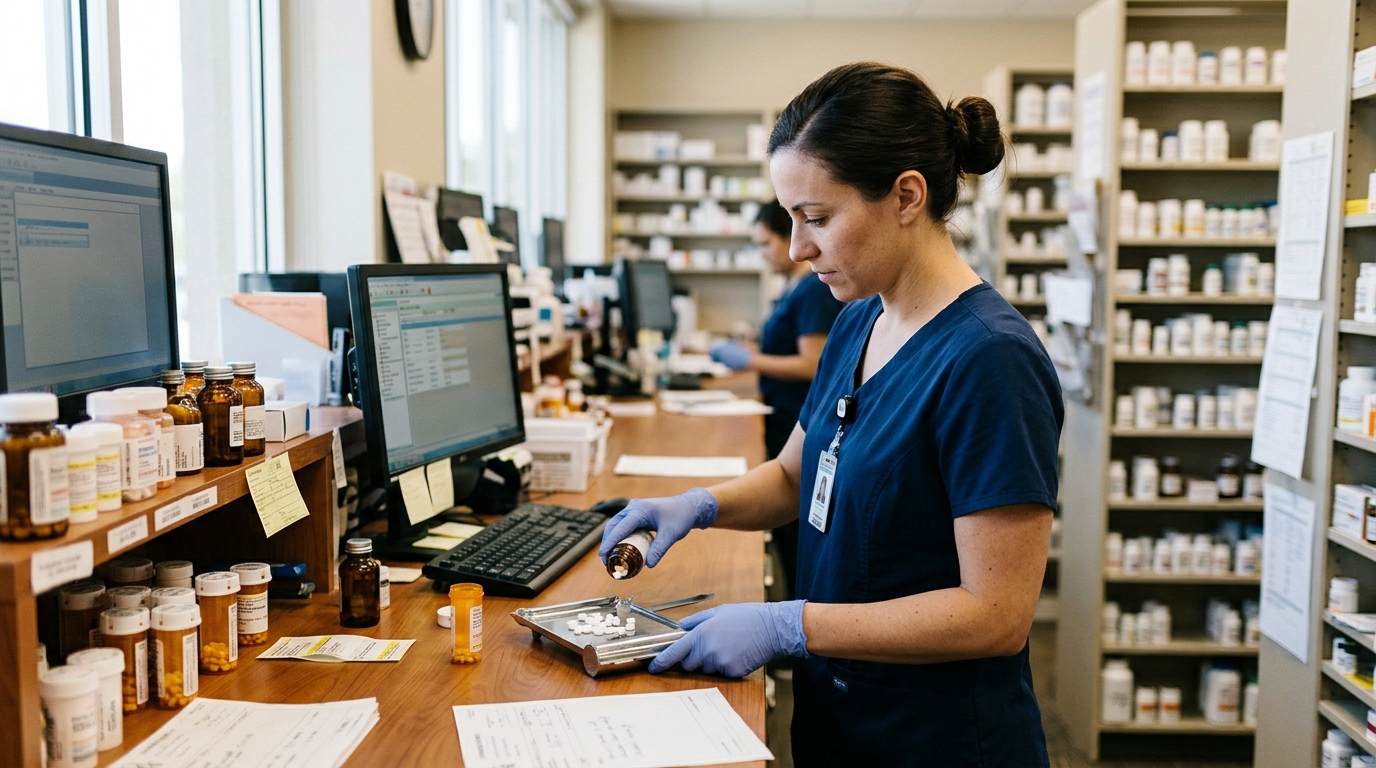
Most of a shift is order processing. You take in new prescriptions and refill requests, key them into the pharmacy management system, pull the correct stock bottle by National Drug Code (NDC), count or pour the quantity on a counting tray with a spatula, label the vial, and place it in a bin for the pharmacist's final check. You translate sig codes into directions, scan barcodes to confirm the right drug and strength, and flag anything that needs the pharmacist — clinical questions, counseling, and final verification are not yours to do.
The other large block of time is insurance. You submit claims for adjudication, work rejections (refill too soon, prior authorization required, quantity limits, wrong plan information), call plans or prescriber offices, and explain to patients why a claim came back. In retail you also run the register, answer phones, and restock shelves.
Hospital and long-term care work shifts the task mix. There you may fill unit-dose carts and automated dispensing cabinets, deliver medications to floors, log and count controlled substances, manage expiration-date checks, and — if trained for it — compound sterile preparations in a cleanroom using a laminar airflow hood and aseptic technique, or non-sterile preparations such as creams and oral suspensions.
Settings and schedules vary. The U.S. Bureau of Labor Statistics (2025) describes pharmacy technicians as working mainly in pharmacies and health care settings, with schedules that include evenings, weekends, and holidays because many pharmacies operate long hours and hospital pharmacies run around the clock. Retail shifts are commonly eight hours; hospital shifts are often eight to twelve, with night and rotating weekend coverage. The work is largely standing, with repeated keyboard and counting tasks, and in a busy store the phone and the queue run at the same time.
Step-by-Step Path to Entry
Steps 1 and 2 must come first. After that, training, certification, and state registration often overlap — many people study for the exam while working in a trainee role.
- Finish high school or earn an equivalency credential. The U.S. Bureau of Labor Statistics (2025) lists a high school diploma or equivalent as the typical entry-level education. Both PTCB and NHA also build this into their eligibility rules: PTCB's pathways for the PTCE require a high school diploma or equivalent (or completion of a recognized education program), and NHA requires a high school diploma or equivalent, or completion of a technician training program, for the ExCPT.
- Read your state board of pharmacy's technician rules before spending money. This determines everything that follows. Florida, for example, licenses Registered Pharmacy Technicians through its Board of Pharmacy; South Carolina's Board of Pharmacy (Labor, Licensing and Regulation) sets a training-hour requirement for state certification. Other states regulate differently or more lightly. Write down three things: whether registration is required, whether a national certification is required or accepted, and what training must be documented. Allow a week of research.
- Choose a training route. CareerOneStop describes employer on-the-job training and formal postsecondary programs as typical entry paths, and the U.S. Bureau of Labor Statistics (2025) notes technicians commonly learn on the job. Employer training is paid and runs weeks to months; a community college or vocational certificate typically runs about two semesters; an associate degree in pharmacy technology runs about two years full time. Tuition is set per credit hour by the school — get the published cost per credit and the total program credits in writing.
- Apply for state registration or a trainee permit if your state requires one. This usually means an application to the board, a fee the board publishes, and in many states a fingerprint-based criminal background check. Processing is commonly a matter of weeks; apply as early as the board allows, because in some states you cannot work in the pharmacy until it clears.
- Apply for and sit a certification exam. The PTCE is a computer-based, multiple-choice exam scored on a scaled range with a passing score set by PTCB; the ExCPT is also computer-based and multiple-choice. PTCB and NHA each publish their current application and exam fees, retake rules, and testing-window policies on their own sites — check those directly, as fees change. Budget two to four months of structured study if you are not already working in a pharmacy.
- Apply for jobs with the documents employers ask for. Retail chains, hospitals, mail-order pharmacies, and long-term care pharmacies all hire technicians. If you have no pharmacy experience, employers substitute something verifiable for it: completion of a technician training program, a current state registration, employer on-the-job training hours, or a passed PTCE or ExCPT. Say which of those you hold in the first line of your application.
- Keep the credential current. PTCB requires continuing education and periodic renewal to keep the CPhT active; NHA sets its own recertification cycle. Check the current hour requirements and renewal fee with the certifying body, and separately with your state board, which may set its own continuing education rules.
Education and Certification Options Compared
| Path | Credential earned | Typical duration | Typical cost | Satisfies state licensing? |
|---|---|---|---|---|
| Employer on-the-job training (retail or hospital) | No academic credential; documented training hours | Weeks to several months | Usually paid training, no tuition | Depends on the state; some boards accept documented employer hours, such as South Carolina's training-hour requirement |
| Community college or vocational certificate in pharmacy technology | Certificate or diploma | About two semesters (roughly 9-12 months) | Tuition per credit hour, set by the school | Commonly accepted as the required training; confirm with your board |
| Associate degree in pharmacy technology | Associate of Applied Science | About two years full time | Tuition per credit hour, set by the college | Same as certificate; the degree itself is not a license |
| PTCB Pharmacy Technician Certification Exam (PTCE) | Certified Pharmacy Technician (CPhT) | Exam sat once an eligibility pathway is met; 2-4 months typical study | Application and exam fee published by PTCB | Required or accepted by some states; not a substitute for registration |
| NHA ExCPT exam | Certified Pharmacy Technician (CPhT) | Exam sat once eligibility is met | Exam fee published by NHA | NHA (2019) states the ExCPT is accepted across states; verify with your board |
| State registration or licensure (for example, Florida Registered Pharmacy Technician) | State registration/licence | Application processing, commonly weeks | Fee set by the state board | This is the licence itself, where the state requires one |
The measurable differences are duration and tuition: employer training costs no tuition but ties you to one employer's scope, a certificate program runs roughly two semesters, and an associate degree runs about twice as long for the same technician credential. Certification exams are separate from all of these and carry their own fee.
Requirements Checklist Before You Apply
- Hold a high school diploma or a recognized equivalency credential, or be within the completion window your certifying body allows.
- Have confirmed in writing whether your state board of pharmacy requires registration, licensure, or a trainee permit before you can work in a pharmacy.
- Have met any state-mandated training hours, such as the hours South Carolina's Board of Pharmacy requires for state certification, and have documentation of them.
- Have submitted a state registration application where required (for example, Florida's Registered Pharmacy Technician licence) and have the application or licence number to quote.
- Be able to pass a criminal background check, including fingerprinting where the state board or employer requires it, and be prepared to disclose prior convictions on board and employer forms as asked.
- Meet one certifying body's eligibility rules — PTCB's pathways for the PTCE, or NHA's requirements for the ExCPT — if the job posting asks for a CPhT.
- Have a passing exam result, a scheduled exam date, or a stated timeline for sitting it, if the employer requires certification within a set period of hire.
- Be legally eligible to work in the United States and able to produce the documentation the employer requires at onboarding.
- Be available for the schedule the role actually runs: the U.S. Bureau of Labor Statistics (2025) notes evening, weekend, and holiday hours are common, and hospital pharmacies staff around the clock.
- Be able to perform basic pharmacy calculations — conversions, days' supply, and dosage quantities — since many employers test this at interview.
Frequently asked questions
Do I have to be certified to work as a pharmacy technician?
It depends on your state. The U.S. Bureau of Labor Statistics (2025) notes that pharmacy technician requirements are set at state level, and some states require registration, certification, or both. Florida licenses Registered Pharmacy Technicians through its Board of Pharmacy; South Carolina's board sets training hours for state certification. Check your own board before enrolling anywhere. Many employers require a CPhT within a set period after hire even where the state does not.
PTCE or ExCPT — which exam should I take?
Both lead to the CPhT title. The PTCE is issued by the Pharmacy Technician Certification Board; the ExCPT is issued by the National Healthcareer Association, which states (2019) that the ExCPT is accepted across states. Both are computer-based, multiple-choice exams. Decide by two checks: which exam your state board names in its rules, and which one local employers list in job postings. Fees are published by each body and change, so check them directly.
How long does it take to start working?
If your state allows employer on-the-job training, you can be in a trainee role within weeks of hire, with registration processing often taking a few weeks. A community college certificate typically runs about two semesters, roughly 9-12 months; an associate degree runs about two years full time. Add two to four months of study before sitting the PTCE or ExCPT if you are not already working in a pharmacy.
Can I get hired with no pharmacy experience?
Employers substitute something verifiable for experience: completion of a technician training program, a current state registration or trainee permit, documented employer training hours, or a passed PTCE or ExCPT. The U.S. Bureau of Labor Statistics (2025) lists on-the-job training as part of the typical route, which is why trainee roles exist. Lead your application with whichever of those four you already hold.
What do pharmacy technicians get paid?
Pay is usually hourly, with differentials for evening, overnight, weekend, and holiday shifts, and often a pay bump for holding a CPhT or for sterile compounding duties. The U.S. Bureau of Labor Statistics publishes a median annual wage and full wage percentiles for pharmacy technicians (SOC 29-2052) through its Occupational Outlook Handbook and Occupational Employment and Wage Statistics program — look up the current figures there, and filter by your state and industry.
Is the occupation growing?
The U.S. Bureau of Labor Statistics (2025) publishes a 2025-35 employment projection and an estimate of annual job openings for pharmacy technicians, and O*NET OnLine (2025) reports national employment trend data for the same occupation code, 29-2052.00. Check the current projection and openings figures in the Occupational Outlook Handbook, then compare against your own state's data, since retail and hospital staffing patterns differ considerably by region.
Sources
- U.S. Bureau of Labor Statistics — Pharmacy Technicians : Occupational Outlook Handbook (2025)
- jobdescription.org (citing BLS OEWS) — Pharmacy Technician Job Description, Salary & Career Outlook (2025)