What Does a Warehouse Worker Do? A Day in the Life
From the first scanner login to the last trailer seal, here is how a warehouse shift is structured and what gets counted, lifted and checked along the way.
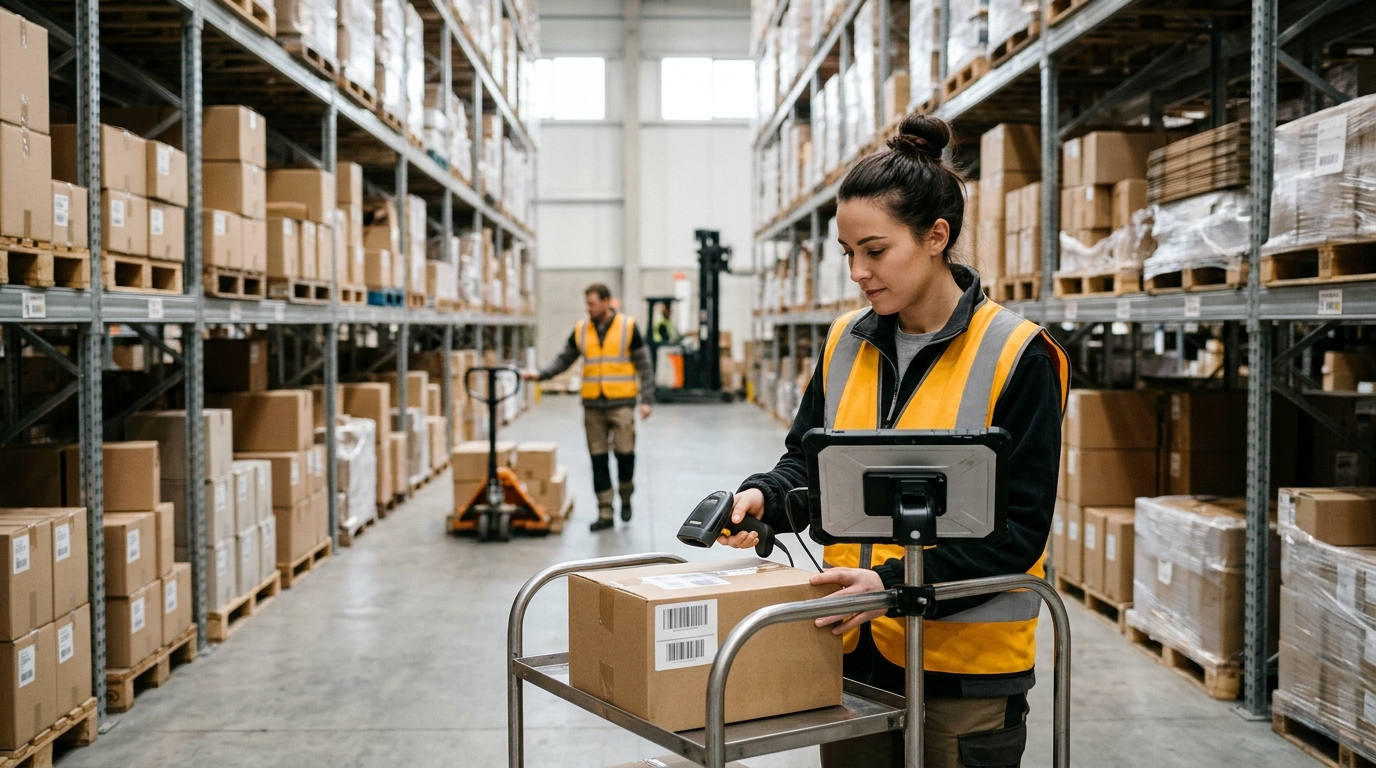
A warehouse worker moves goods through a building: receiving trailers, putting stock away, picking customer orders, packing cartons and loading outbound freight, usually guided by a handheld scanner and a warehouse management system. Most of the shift is spent standing, walking and lifting inside a distribution center, cold store, manufacturing plant or retail backroom.
The U.S. Bureau of Labor Statistics (2025) counts this work under hand laborers and material movers, and publishes the typical entry-level education, on-the-job training and pay for that group. Requirements and pay vary widely by employer, state and industry, so check the current figures for your area before you judge an offer.
What a Warehouse Worker Does
A warehouse worker keeps inventory moving through a building so that orders ship on time and stock records stay accurate. You might work in a retail distribution center, a third-party logistics (3PL) facility, a grocery cold store, a manufacturing plant's shipping department, a parts depot or a port-adjacent cross-dock.
The tasks are physical and system-driven at the same time. You unload trailers and check cartons against the packing list, scan pallets into locations, pick orders to a cart or pallet jack, pack and label cartons, and stage outbound freight at a dock door. A warehouse management system such as SAP EWM, Manhattan or Oracle WMS tells you where to go next, usually through an RF handheld, a voice headset or a wrist scanner.
You report to a shift supervisor or area lead and work alongside forklift operators, inventory control clerks, quality checkers and truck drivers. The U.S. Bureau of Labor Statistics (2025) publishes which industries employ the most hand laborers and material movers and how many jobs the group holds.
Core Duties and Responsibilities
- Unload inbound trailers and containers by hand or with an electric pallet jack, and count cartons against the bill of lading.
- Scan received stock into storage locations using an RF handheld or voice-pick headset.
- Pick customer orders from racking, flow lanes or pick faces, and build stable mixed pallets.
- Pack cartons, apply shipping labels and seal loads with stretch wrap or banding.
- Operate a sit-down counterbalance forklift, reach truck, order picker or walkie rider where you hold a current employer evaluation.
- Stage and load outbound freight by dock door and seal trailers, recording seal numbers.
- Conduct cycle counts and report quantity or location discrepancies to inventory control.
- Complete a pre-shift equipment inspection sheet for any powered truck you use, and tag out faulty equipment.
- Clear aisles, break down cardboard and keep fire exits and sprinkler clearances unobstructed.
- Flag damaged stock, mispicks and short shipments so the team can correct records before cutoff.
A Typical Day
Shift start (often 6 AM, 2 PM or 10 PM) — Badge in, join the stand-up huddle for volume and safety notes, collect your RF scanner, and run the pre-use inspection on your pallet jack or forklift.
First two hours — Unload scheduled inbound trailers, scan pallets, and put stock away to the locations the system assigns. Receiving usually runs hardest early so that stock is available to pick.
Mid-morning — Switch to picking. You follow the scanner from location to location, confirming check digits and quantities, and build pallets or totes for specific routes.
Break and midday — A paid or unpaid break, then packing and labeling, or replenishing pick faces that have run low.
The unpredictable hour — A hot order, a trailer that arrives two hours late, a pallet that falls and has to be re-worked, or a count that does not match the system. Work stops in that aisle until inventory control clears it, and the team re-sequences the remaining picks.
Final two hours — Stage outbound freight by door, load trailers in route order, seal them and record the seal numbers.
End of shift — Plug equipment into chargers, sweep your zone, hand over open issues to the next shift.
Work Environment
- Indoors in a high-bay building, on concrete, standing and walking for most of an eight- to twelve-hour shift, with repeated lifting; many job postings set a standard such as lifting 50 pounds repeatedly and occasionally more with help.
- Dock doors open to the weather, so you work in outside temperatures much of the year; O*NET (undated) reports the share of workers in this group exposed to all weather conditions, and cold stores run below freezing with issued freezer gear.
- Noise from conveyors, forklift horns, strapping machines and reversing alarms; O*NET (undated) reports the share of workers who wear safety shoes, glasses, gloves, hearing protection and hard hats.
- Shift patterns include nights, early mornings, weekends and peak-season overtime; the U.S. Bureau of Labor Statistics (2025) describes the usual schedule pattern, and O*NET (undated) reports the share whose week runs longer than 40 hours.
- Travel is effectively zero — you stay on one site, apart from yard moves between dock and trailer.
- The U.S. Bureau of Labor Statistics (2025) reports the injury and illness rate for hand laborers and material movers relative to other occupations, which is why lift technique, spotter rules and high-visibility vests are enforced.
Skills and Qualifications
| Requirement | Detail |
|---|---|
| Typical entry-level education | The U.S. Bureau of Labor Statistics (2025) publishes the typical entry-level education for hand laborers and material movers; a high school diploma or GED takes four years, or a few months of GED study if you test for it. |
| On-the-job training | Employers train new hires on site; the U.S. Bureau of Labor Statistics (2025) publishes the typical duration needed, and O*NET (undated) assigns the occupation a Job Zone level that reflects it. |
| Powered industrial truck (forklift) certification | OSHA requires the employer to train, certify and periodically re-evaluate operators. Classroom and practical evaluation are often completed within one shift, and the certification belongs to that employer. |
| OSHA 10-Hour General Industry card | Ten hours of safety training, usually over one or two days through an OSHA-authorized trainer. Not universally required, but common in 3PL and manufacturing sites. |
| Commercial Driver's License (CDL Class A or B) | The U.S. Bureau of Labor Statistics (2025) notes some workers in this group, such as refuse and recyclable material collectors driving larger trucks, need a license. Entry-level driver training plus a state skills test typically takes several weeks; rules are set state by state. |
| Scanner and WMS familiarity | RF handhelds, voice-pick headsets and systems such as SAP EWM, Manhattan or Oracle WMS. Learned on the job in days, not months. |
| Physical capability | Employers commonly run a lift or functional test at hire, covering repeated lifting, bending and standing for a full shift. |
Salary and Job Outlook
Pay is nearly always hourly, with overtime after 40 hours and shift differentials for nights, weekends and peak season. Some sites add attendance or productivity bonuses. Use the sources below for current figures rather than a recruiter's estimate.
| Measure | Where to check it |
|---|---|
| Entry-level pay | The 10th-percentile wage for hand laborers and material movers, published by the U.S. Bureau of Labor Statistics (2025). |
| Median pay | The 2025 median pay for hand laborers and material movers, U.S. Bureau of Labor Statistics (2025); O*NET OnLine (2025) also lists a median for Laborers and Freight, Stock, and Material Movers, Hand (SOC 53-7062). |
| Experienced pay | The 90th-percentile wage for the same group, U.S. Bureau of Labor Statistics (2025). |
| Pay by state and metro area | Occupational Employment and Wage Statistics for SOC 53-7062, U.S. Bureau of Labor Statistics (May 2023), which breaks the figures down by area. |
| Projected growth | Projected employment growth for 2025-35, U.S. Bureau of Labor Statistics (2025). |
| Annual openings | Projected annual job openings for 2025-35, U.S. Bureau of Labor Statistics (2025), alongside the total number of jobs the group holds. |
How to Get Started
- Confirm you can meet the physical standard an employer will test: repeated lifting around 50 pounds, standing a full shift, and climbing on and off equipment. Build up to it before the hire-day lift test, not after.
- Get a high school diploma or GED if you do not have one, and check the typical entry-level education the U.S. Bureau of Labor Statistics (2025) lists for this group, since some employers set no formal credential.
- Take an OSHA 10-Hour General Industry course through an OSHA-authorized trainer. It is ten hours of instruction and the card gives a hiring manager something concrete to see.
- Apply directly through distribution-center careers pages and through staffing agencies that fill warehouse temp-to-hire roles. Agencies often place first-time workers who have no warehouse history.
- Once hired, ask to be put through your employer's powered industrial truck training. OSHA requires the employer to certify and periodically re-evaluate operators, so the certification comes from the site, not a course you buy beforehand.
- If you want to move to driving, start a commercial driver's license (Class A or B) through your state's licensing process; the U.S. Bureau of Labor Statistics (2025) notes some material-moving roles require one.
Frequently asked questions
Do I need experience to get a warehouse job?
Most sites hire with no warehouse history and train you on the floor; the U.S. Bureau of Labor Statistics (2025) publishes the typical on-the-job training needed for hand laborers and material movers. What employers usually test at hire is physical capability — often repeated lifting in the region of 50 pounds — and reliable attendance. Staffing agencies running temp-to-hire contracts are the most common entry route.
Is a forklift certificate something I buy before applying?
OSHA puts the duty on the employer to train, certify and periodically re-evaluate powered industrial truck operators, so certification is site-specific and does not transfer cleanly between companies. An outside course can show familiarity with a sit-down counterbalance or reach truck, but your new employer will still run its own evaluation. Listing prior forklift hours on an application still helps.
How physically demanding is the work?
You stand and walk on concrete for most of an eight- to twelve-hour shift, lift and carry repeatedly, and work near dock doors open to outside temperatures. The U.S. Bureau of Labor Statistics (2025) reports the injury and illness rate for this occupation group relative to others, and O*NET (undated) reports the share of workers who wear safety shoes, glasses, gloves, hearing protection and hard hats. Cold-store roles add insulated gear and timed warm-up breaks.
What hours should I expect?
Warehouses typically run two or three shifts, so nights, early mornings and weekends are normal, and peak season brings mandatory overtime at many sites. The U.S. Bureau of Labor Statistics (2025) describes the usual schedule pattern for this group, and O*NET (undated) reports the share whose work week runs beyond 40 hours. Shift differentials for nights and weekends are common but vary by employer and state.
Where can the job lead?
Common next steps are forklift operator, inventory control clerk, quality checker, shift lead and then supervisor, usually promoted internally after a year or two on the floor. Another route is driving: the U.S. Bureau of Labor Statistics (2025) notes some material-moving roles require a commercial driver's license, and entry-level driver training plus a state skills test typically takes several weeks rather than years.
Sources
- U.S. Bureau of Labor Statistics — Hand Laborers and Material Movers : Occupational Outlook Handbook (2025)
- O*NET OnLine — 53-7062.00 - Laborers and Freight, Stock, and Material Movers, Hand (2025)