Warehouse Worker vs Forklift Operator: Which Job Fits You?
Both jobs move freight through the same building, but one is on its feet all shift and the other is behind the controls — here is how to tell them apart.
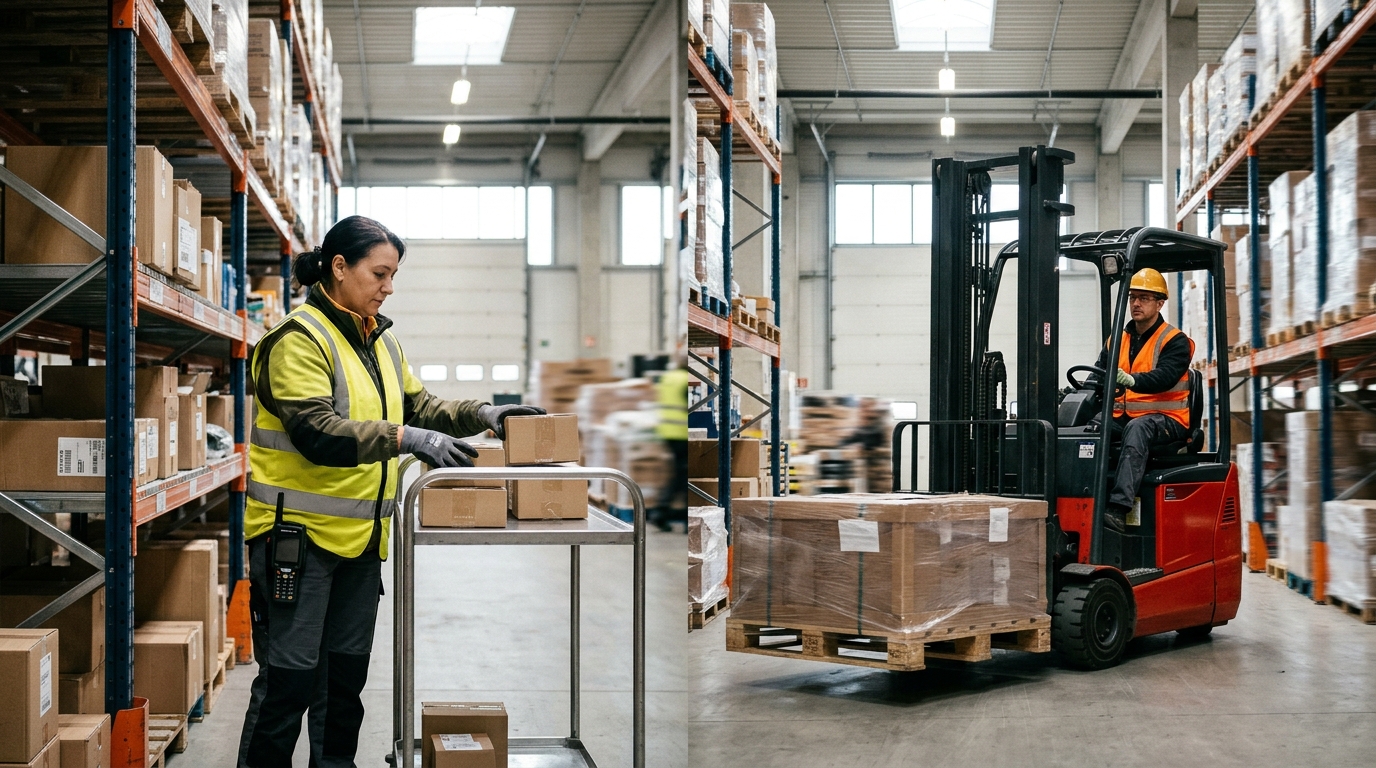
Warehouse workers (counted by the government as hand laborers and material movers) load, unload, scan and stack freight by hand for a full shift. Forklift operators (industrial truck and tractor operators) spend most of their shift seated at the controls of a powered truck, moving pallets that are too heavy to lift by hand.
The two roles often sit in the same aisle, under the same supervisor, on the same shift pattern. The real differences are in training, physical wear, and the wage tables each job is reported under.
Side-by-Side Comparison
| Factor | Warehouse worker (hand laborer / material mover) | Forklift operator (industrial truck and tractor operator) |
|---|---|---|
| Median pay | Reported as a median annual wage for Hand Laborers and Material Movers (U.S. Bureau of Labor Statistics, 2025). Paid hourly in almost all warehouses, with overtime after 40 hours in a week and extra per hour on night and weekend shifts. | Reported separately for Industrial Truck and Tractor Operators and again inside the wider Material Moving Machine Operators group (U.S. Bureau of Labor Statistics, 2025). Also hourly; many sites add a per-hour premium once you hold a current operator certification. Pull both medians from the Occupational Outlook Handbook and your state workforce agency before deciding. |
| Typical hours | Most work full time; evening, overnight and weekend shifts are common where the facility runs around the clock (U.S. Bureau of Labor Statistics, 2025). Peak-season mandatory overtime is normal in retail and parcel operations. | Most work full time, including evening and overnight shifts (U.S. Bureau of Labor Statistics, 2025). Operators are often held past shift end to finish loading an outbound trailer. |
| Education required | A typical entry-level education level and short-term on-the-job training are listed for this occupation (U.S. Bureau of Labor Statistics, 2025); ONET assigns it a preparation level, or Job Zone (ONET OnLine, U.S. Department of Labor). | An education requirement and a training period for learning to operate industrial trucks are listed (U.S. Bureau of Labor Statistics, 2025), plus a Job Zone preparation level (O*NET OnLine). Employers run classroom instruction and a hands-on driving evaluation on each truck class before you drive alone. |
| Physical demands | Stand, walk, bend, climb into trailers and lift by hand for the whole shift; the work is physically demanding and hand laborers and freight, stock and material movers rank among occupations with higher injury and illness rates (U.S. Bureau of Labor Statistics, 2025). Job ads commonly specify repeated lifting of 50 pounds. | Seated at the controls most of the shift, twisting to look behind while reversing, climbing on and off the truck dozens of times. Operators report regular use of a hard hat, hi-vis vest, safety footwear and hearing protection (O*NET OnLine, U.S. Department of Labor). |
| Primary duties | Load and unload trucks, move freight and stock by hand, pack and wrap orders, and keep aisles clear (U.S. Bureau of Labor Statistics, 2025). | Operate powered industrial trucks to move materials around the facility and load and unload trailers and rail cars (U.S. Bureau of Labor Statistics, 2025). |
Day-to-Day Differences
A warehouse worker's hour looks like this: break down a pallet case by case, scan each carton with an RF handheld, drag a manual pallet jack to the staging lane, shrink-wrap the finished pallet, cut and flatten cardboard, then climb into a trailer and hand-stack floor-loaded freight to the ceiling. You touch the product constantly. You also sweep aisles, clear dunnage and restack leaners before an inspection.
A forklift operator's hour is built around the machine. You complete a pre-shift inspection sheet — forks, chains, horn, brakes, battery or propane level — then spend the shift lifting pallets off trailers, placing them into racking two or three levels up, and feeding pallets to the pick line. You swap or charge a battery mid-shift, square up a load that shifted in transit, and drop empties back to the dock.
The overlap is real: most operators still hand-stack when the trucks are idle, and most warehouse workers get asked to pull a pallet jack. The split is how much of the shift is spent lifting versus steering, and how much of it you spend seated rather than walking concrete.
Who Each Job Fits Best
Warehouse worker fits you if:
- You can lift and carry repeatedly — the 50-pound cartons in job postings are real, and the occupation ranks among those with higher injury and illness rates (U.S. Bureau of Labor Statistics, 2025).
- You want to start fast, on short-term on-the-job training rather than a classroom course (U.S. Bureau of Labor Statistics, 2025).
- You would rather keep moving than sit, and you don't mind unloading a floor-loaded trailer in summer heat or winter cold.
- You want a route into a certification: many sites train their own warehouse staff onto the trucks.
Forklift operator fits you if:
- You can hold concentration on a repetitive task — travelling reverse, judging a fork entry 20 feet up, keeping pedestrians in view all shift.
- You accept a daily inspection routine and documentation rather than treating checks as optional.
- You want less hand-lifting but still accept climbing on and off the truck and wearing a hard hat, hi-vis vest and hearing protection (O*NET OnLine, U.S. Department of Labor).
- You are willing to recertify and to be re-evaluated by your employer on each new truck class you drive.
Pay and Advancement
| Measure | Warehouse worker | Forklift operator |
|---|---|---|
| Entry pay | Hourly starting rate set by the site, plus shift differential for nights and weekends and overtime past 40 hours. Compare against the Hand Laborers and Material Movers wage data (U.S. Bureau of Labor Statistics, 2025) and your state's figures. | Hourly, commonly with a certified-operator premium added to the general labor rate at the same site. Compare against the Industrial Truck and Tractor Operators wage data (U.S. Bureau of Labor Statistics, 2025). |
| Median pay | Median annual wage published for Hand Laborers and Material Movers (U.S. Bureau of Labor Statistics, 2025). | Median annual wage published for Industrial Truck and Tractor Operators, and for the broader Material Moving Machine Operators group (U.S. Bureau of Labor Statistics, 2025). |
| Typical path to the next role | Get certified on a sit-down forklift at your own site, then move to inventory control or cycle counting, shipping and receiving clerk, or team lead. Employment is projected to change over 2025–35 (U.S. Bureau of Labor Statistics, 2025). | Add reach truck, order picker and clamp attachments, then move to lead driver or in-house trainer, dock coordinator, or inventory roles using the warehouse management system. A 2025–35 projection is published for this occupation too (U.S. Bureau of Labor Statistics, 2025). |
Frequently asked questions
Can I get a forklift job with no warehouse experience?
Plenty of employers train from scratch, because they have to evaluate you on their own trucks regardless of what you bring. Where experience helps is competition: a site hiring one operator will often pick someone already working its floor as a hand laborer. Many people take the general warehouse job first and ask to be put through training after a few months.
Which job is harder on your body?
Hand labor, clearly. The occupation is described as physically demanding, and hand laborers and freight, stock and material movers rank among those with higher injury and illness rates (U.S. Bureau of Labor Statistics, 2025), largely from repeated lifting, carrying and trailer unloading. Operating is easier on the back, but it brings its own strain from twisting to reverse, vibration, and climbing on and off the truck all shift.
Which has more job openings?
Hand laborers and material movers is by far the larger occupation by headcount, with industrial truck and tractor operators a much smaller group (U.S. Bureau of Labor Statistics, 2025). That means more postings and faster hiring for general warehouse work, but more competition per operator seat. Both have published 2025–35 employment projections worth reading before you commit.
Does a forklift certification transfer between employers?
Only partly. Training content carries over and counts for a lot on an application, but each employer evaluates you on its own equipment and site before letting you drive unsupervised, and certification is tied to the truck classes you were tested on. Keep a copy of your training records and note which machines you have driven — sit-down counterbalance, reach truck, order picker — when you apply.
Sources
- U.S. Bureau of Labor Statistics — Hand Laborers and Material Movers : Occupational Outlook Handbook (2025)
- U.S. Bureau of Labor Statistics — Material Moving Machine Operators : Occupational Outlook Handbook (2025)