Veterinary Technician vs Veterinary Assistant: Which One Fits You Better?
One path runs through an accredited two-year program and a national exam; the other starts with a high school diploma and training on the clinic floor.
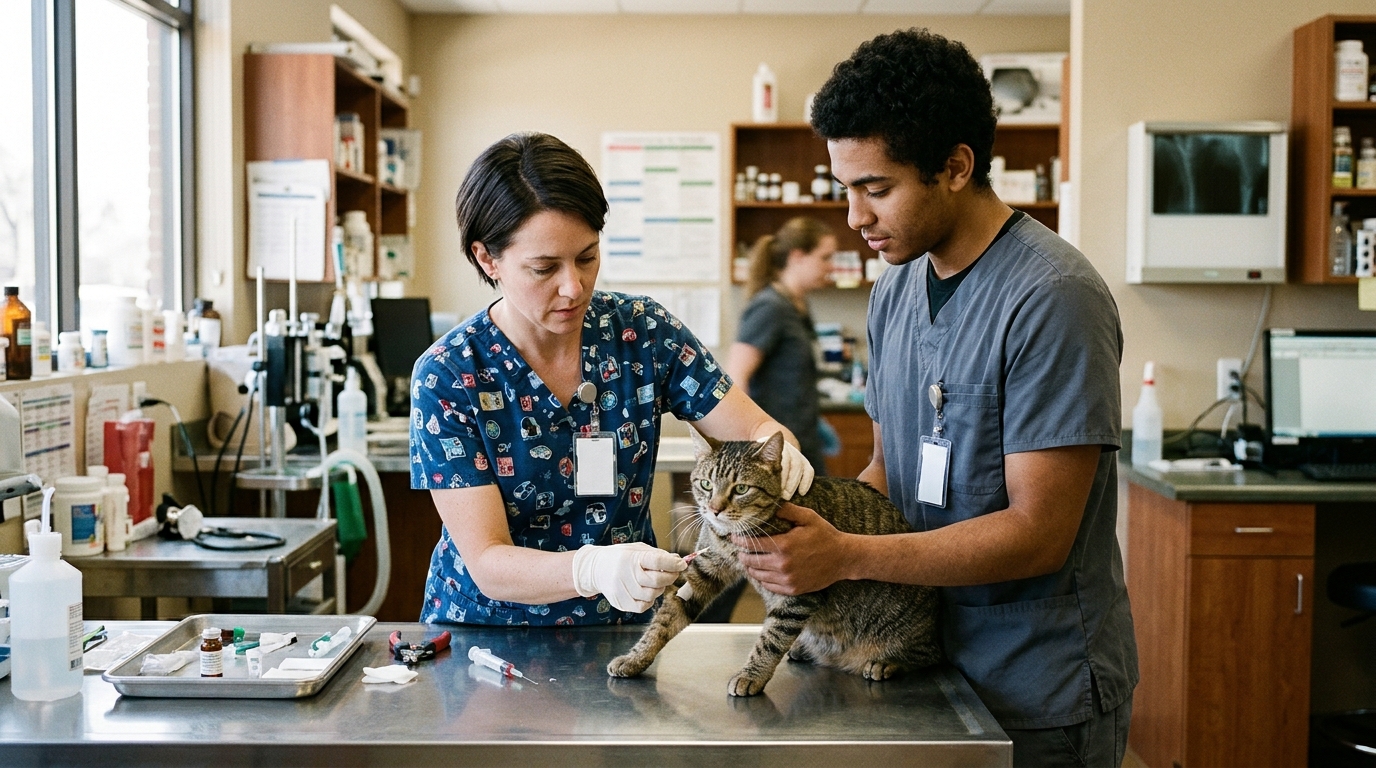
Veterinary technicians and veterinary assistants work side by side in the same treatment rooms, but they get there by very different routes. Technicians complete a postsecondary veterinary technology program — usually a two-year associate degree — and typically pass a credentialing exam to be registered, licensed or certified depending on the state, while most assistants enter with a high school diploma or equivalent and learn on the job (U.S. Bureau of Labor Statistics, 2025).
That gate changes what you are allowed to do with a patient, what you are paid, and how long it takes to start. Below, both jobs are compared on the same metrics so you can see which trade-off you would rather make.
Veterinary Technician vs Veterinary Assistant at a Glance
| Metric | Veterinary Technician | Veterinary Assistant |
|---|---|---|
| Typical entry-level education | Associate's degree in veterinary technology (U.S. Bureau of Labor Statistics, 2025) | High school diploma or equivalent plus short-term on-the-job training (U.S. Bureau of Labor Statistics, 2025) |
| Median pay | $47,380 a year, $22.78 an hour, for veterinary technologists and technicians in May 2025 (U.S. Bureau of Labor Statistics, 2025) | $38,150 a year, $18.34 an hour, for veterinary assistants and laboratory animal caretakers in May 2025 (U.S. Bureau of Labor Statistics, 2025) |
| Typical hours | Many work evenings, weekends or holidays (U.S. Bureau of Labor Statistics, 2025) | Set by the employer's opening hours; emergency and 24-hour hospitals staff nights and weekends, day practices usually do not — check the shift pattern in the job posting |
| Physical and emotional demands | Work may be physically or emotionally demanding (U.S. Bureau of Labor Statistics, 2025) | Work may be physically and emotionally demanding (U.S. Bureau of Labor Statistics, 2025) |
| Entry barrier | Complete a postsecondary veterinary technology program and typically pass a credentialing exam such as the Veterinary Technician National Examination (VTNE) from the American Association of Veterinary State Boards, then register, license or certify depending on the state (U.S. Bureau of Labor Statistics, 2025) | Most learn the occupation on the job after being hired with a high school diploma or equivalent; some employers look for the Certified Veterinary Assistant title (U.S. Bureau of Labor Statistics, 2025; O*NET OnLine, U.S. Department of Labor) |
| Preparation level (O*NET Job Zone) | Job Zone Three, "Medium Preparation Needed" (O*NET OnLine, U.S. Department of Labor) | Job Zone 1–2, "Very Little to Some Preparation Needed" (O*NET OnLine, U.S. Department of Labor) |
| Common first job title | Veterinary Technician (Vet Tech), Registered Veterinary Technician (RVT), Licensed Veterinary Technician (LVT), Certified Veterinary Technician (CVT) (O*NET OnLine, U.S. Department of Labor) | Veterinary Assistant (Vet Assistant), Certified Veterinary Assistant, Animal Care Provider, Animal Caregiver (O*NET OnLine, U.S. Department of Labor) |
| Signature listed task | "Administer anesthesia to animals, under the direction of a veterinarian, and monitor animals' responses to anesthetics so that dosages can be adjusted" (O*NET OnLine, U.S. Department of Labor) | "Assist veterinarians in examining animals to determine the nature of illnesses or injuries" (O*NET OnLine, U.S. Department of Labor) |
| Jobs and outlook | 131,400 jobs in 2025; 9 percent growth projected 2025–2035, about 13,400 annual openings (U.S. Bureau of Labor Statistics, 2025) | 132,100 jobs in 2025; 9 percent growth projected 2025–2035, about 23,200 annual openings (U.S. Bureau of Labor Statistics, 2025) |
Pay varies by state, by employer type and by setting — a research laboratory, a specialty referral hospital and a two-doctor small-animal practice do not pay alike. Check current figures for your state and metro area in the Bureau of Labor Statistics Occupational Employment and Wage Statistics data before you commit to either route.
Where These Careers Overlap
On a Tuesday morning you often cannot tell the two apart from the waiting room. Both roles work in private clinics, animal hospitals and research laboratories (U.S. Bureau of Labor Statistics, 2025), and both spend the day on the same floor doing a lot of the same work.
Shared, concrete tasks include:
- Restraining a frightened cat on its side so blood can be drawn from the jugular, and knowing when to stop and reach for a towel wrap instead.
- Taking temperature, pulse and respiration on an incoming patient and typing it into the medical record before the veterinarian walks in.
- Running the autoclave, packing surgical instruments, mopping kennel runs and doing hospital laundry.
- Feeding, walking and medicating hospitalized patients, including post-operative dogs who are still wobbly.
- Assisting in the exam room: O*NET lists assisting veterinarians in examining animals as a task for assistants, and technicians do the same holding, history-taking and client questions.
Both jobs can be physically and emotionally demanding (U.S. Bureau of Labor Statistics, 2025) — lifting large-breed dogs onto a table, and being in the room for euthanasia appointments.
Where They Diverge
The single biggest practical divergence is scope of practice, and it is enforced by credentialing. Veterinary technologists and technicians must complete a postsecondary veterinary technology program and typically take a credentialing exam and become registered, licensed or certified depending on the state (U.S. Bureau of Labor Statistics, 2025). Veterinary assistants mostly learn on the job after being hired with a high school diploma or equivalent (U.S. Bureau of Labor Statistics, 2025). What each person may legally do with a patient follows from that, and the exact boundary is set by your state's veterinary practice act and board — check theirs, not a national summary.
A scenario for each:
- Technician. A six-year-old spaniel is in for a dental. You place the IV catheter, induce and administer anesthesia under the veterinarian's direction, then watch heart rate, blood pressure, capnograph and temperature for ninety minutes, adjusting the dose when the pressure drops — the anesthesia-monitoring task O*NET lists for the occupation. If the patient destabilizes, the veterinarian's first question is to you.
- Assistant. The same dental: you set up the table, warm the fluid bag, position and hold the patient for radiographs, clean and pack the instruments afterward, call the owner's discharge time through to reception, and sit with the dog in recovery watching for shivering or a mouth full of blood.
One role carries clinical responsibility for the patient under supervision; the other keeps that work possible and the patient comfortable. Decide which you want to be accountable for at 11 a.m. on a surgery day.
Which Path Fits You Better
If you check more boxes in column A, the veterinary technician route fits better. If you check more in column B, start as a veterinary assistant — many people do that first and go to school later.
Column A — Veterinary Technician
- You are willing to spend about two years in a veterinary technology program accredited by the AVMA's Committee on Veterinary Technician Education and Activities, and sit a credentialing exam such as the VTNE.
- You want the higher median wage — $47,380 a year in May 2025 versus $38,150 for assistants (U.S. Bureau of Labor Statistics, 2025) — enough to accept tuition and the delay before your first paycheck.
- You can live with evenings, weekends and holidays, which many technicians work (U.S. Bureau of Labor Statistics, 2025).
- You want the anesthesia chair: inducing, dosing and monitoring a patient under a veterinarian's direction, and being the person the veterinarian asks when the blood pressure falls.
- You are comfortable with ongoing state registration, renewal and continuing education, and with an O*NET Job Zone Three level of preparation.
Column B — Veterinary Assistant
- You need to be earning within weeks, not years, and a high school diploma or equivalent plus on-the-job training is the realistic starting point (U.S. Bureau of Labor Statistics, 2025).
- You would rather take the $38,150 median starting point with no tuition debt and see whether clinic work suits you before enrolling anywhere (U.S. Bureau of Labor Statistics, 2025).
- You want a schedule tied to one practice's posted opening hours, and you will screen out 24-hour emergency hospitals when you apply.
- You would rather learn by restraining, feeding, cleaning and assisting in exams than by passing a board exam.
- You want the widest door in: about 23,200 projected annual openings for assistants and laboratory animal caretakers versus about 13,400 for technicians, 2025–2035 (U.S. Bureau of Labor Statistics, 2025).
Both columns assume you can handle kennel cleaning, lifting patients, and euthanasia appointments — work the Bureau of Labor Statistics describes as physically and emotionally demanding for both occupations (2025).
Frequently asked questions
Can a veterinary assistant become a veterinary technician?
Yes, but not by seniority. You would complete a veterinary technology program accredited by the AVMA's CVTEA — typically two years for the associate degree — and then take a credentialing exam such as the VTNE and meet your state's registration, licensing or certification rules (U.S. Bureau of Labor Statistics, 2025).
Do veterinary technicians need a license in every state?
Requirements differ. Veterinary technologists and technicians typically must take a credentialing exam and become registered, licensed or certified depending on the state (U.S. Bureau of Labor Statistics, 2025). Confirm the exact rule with your own state veterinary board before enrolling in a program.
What is the difference between a veterinary technologist and a veterinary technician?
Program length. Veterinary technologists usually need a four-year bachelor's degree, while veterinary technicians need a two-year associate degree; both typically take a credentialing exam (U.S. Bureau of Labor Statistics, 2025). Some schools offer a Bachelor of Science in Veterinary Technology under CVTEA accreditation.
Which role has more job openings?
Veterinary assistants and laboratory animal caretakers have about 23,200 projected annual openings, against about 13,400 for veterinary technologists and technicians, with both occupations projected to grow 9 percent from 2025 to 2035 (U.S. Bureau of Labor Statistics, 2025).
Sources
- U.S. Bureau of Labor Statistics — Veterinary Technologists and Technicians : Occupational Outlook Handbook (2025)
- U.S. Bureau of Labor Statistics — Veterinary Assistants and Laboratory Animal Caretakers : Occupational Outlook Handbook (2025)