Veterinary Technician vs Veterinary Assistant: Comparing Duties and Training
Two animal-care jobs that share a clinic floor but not a credential: one needs an accredited degree and a state exam, the other starts with on-the-job training.
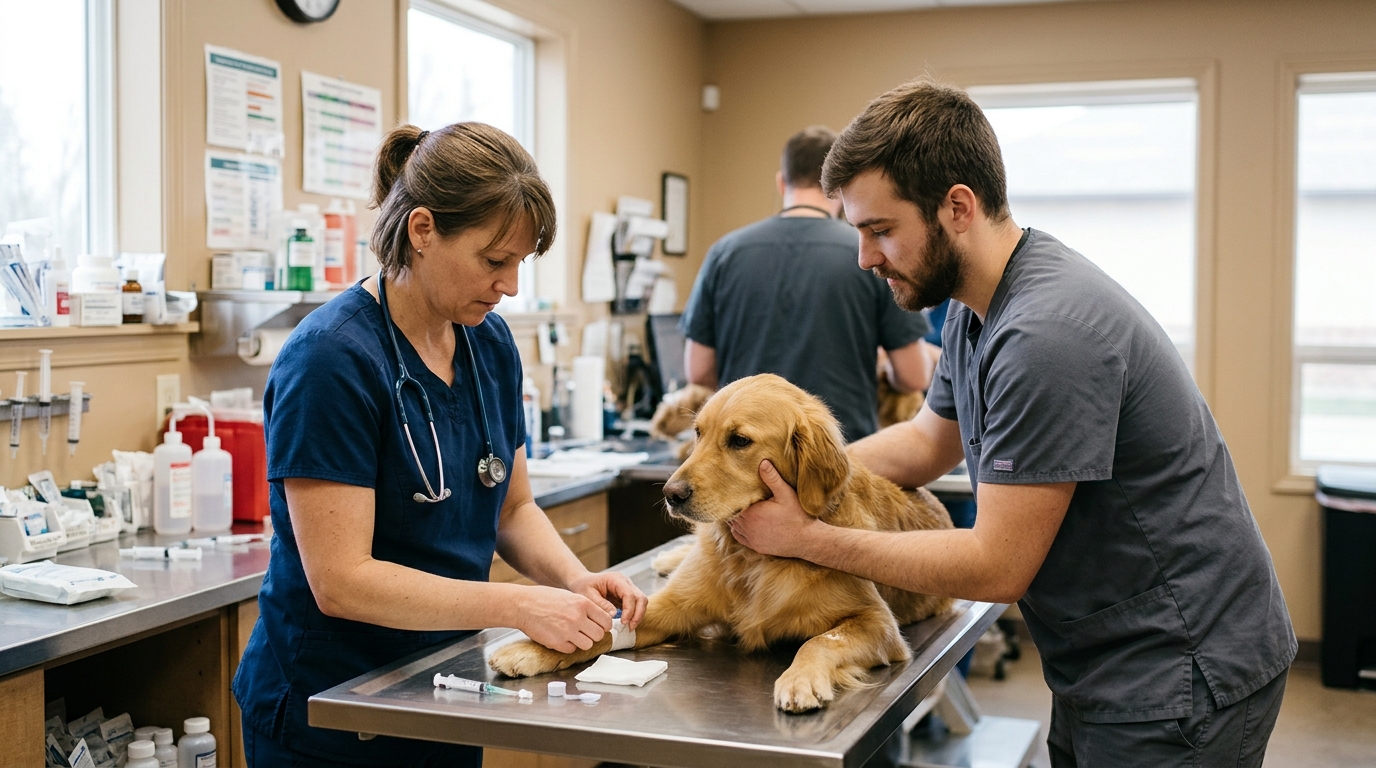
Veterinary technicians and veterinary assistants both work hands-on with animals in clinics, shelters and research facilities, but they are separate occupations with different entry routes. A technician typically completes a two- to three-year AVMA-accredited veterinary technology program and passes the Veterinary Technician National Examination (VTNE) to be credentialed as an LVT, RVT or CVT depending on the jurisdiction (NAVTA, 2020), while assistants usually enter with a high school diploma or equivalent plus short-term on-the-job training, with certification not mandatory (U.S. Bureau of Labor Statistics, 2025).
That difference in training shapes the work: technicians administer anesthesia, take x-rays and run lab tests, while assistants feed, bathe and exercise animals, restrain them during procedures and disinfect cages and operating rooms (U.S. Bureau of Labor Statistics, 2025).
Side-by-Side Comparison
| Factor | Veterinary Technician | Veterinary Assistant |
|---|---|---|
| Median pay | The U.S. Bureau of Labor Statistics publishes a 2025 median pay figure for veterinary technologists and technicians in its Occupational Outlook Handbook; pay is usually quoted as an annual or hourly rate by the clinic and varies by state and employer type, so check the current Handbook entry and your state's wage data. | The Bureau publishes a separate 2025 median pay figure for veterinary assistants and laboratory animal caretakers, which sits below the technician figure; assistant pay is most often quoted hourly. Check the same Handbook page for the current number. |
| Typical hours | Full-time in most clinics, with evening, weekend and holiday shifts, including overnight emergency rotations (U.S. Bureau of Labor Statistics, 2025). | Some assistants work part time, and night, weekend and holiday shifts are common in hospitals and shelters (U.S. Bureau of Labor Statistics, 2025). |
| Education required | Associate degree from an AVMA-accredited veterinary technology program, typically two to three years, plus the VTNE for LVT, RVT or CVT credentialing; a technologist holds a four-year AVMA-accredited bachelor's degree (NAVTA, 2020). Most states require passing an exam to be registered, licensed or certified (U.S. Bureau of Labor Statistics, 2025). | High school diploma or equivalent, followed by short-term on-the-job training; certification is not mandatory (U.S. Bureau of Labor Statistics, 2025). |
| Physical demands | Indoor clinical work, standing for most of a shift, lifting and holding animals for radiographs and surgical prep; one of the highest injury and illness rates of all occupations, with bites, scratches and kicks from scared or aggressive animals (U.S. Bureau of Labor Statistics, 2025). | Indoor kennel, exam-room and shelter work, standing and bending to clean cages and walk dogs; also one of the highest injury and illness rates of all occupations, with the same bite, scratch and kick risks (U.S. Bureau of Labor Statistics, 2025). |
| Primary duties | Observe animal behavior, provide nursing care, administer anesthesia, take x-rays, perform urinalyses and blood counts, and prepare animals and instruments for surgery (U.S. Bureau of Labor Statistics, 2025). | Feed, bathe and exercise animals, clean and disinfect cages and exam and operating rooms, restrain animals during procedures, sterilize surgical instruments, and monitor animals after surgery (U.S. Bureau of Labor Statistics, 2025). |
Day-to-Day Differences
A technician's shift is built around clinical procedures. You induce and monitor anesthesia for a dental or a spay, position a patient and shoot x-rays, then run a urinalysis or a blood count in the in-house lab before the veterinarian reads the results. Between appointments you record observations of animal behavior, deliver nursing care to hospitalized patients, and lay out instruments and prep a patient's surgical site (U.S. Bureau of Labor Statistics, 2025). Much of the day is decision-adjacent: you report findings, flag changes and carry out orders that require a credential in most states.
An assistant's hours track the flow of animals through the building. You feed and water patients, bathe and exercise dogs, hose down and disinfect cages, and scrub the exam and operating rooms between cases. During procedures you restrain the animal so the veterinarian or technician can work, then sterilize the surgical instruments afterward and watch recovering patients for signs of distress (U.S. Bureau of Labor Statistics, 2025).
Both jobs keep you on your feet indoors, around barking, and within reach of animals that bite, scratch and kick — which is why both rank among the occupations with the highest injury and illness rates (U.S. Bureau of Labor Statistics, 2025).
Who Each Job Fits Best
Veterinary technician suits you if:
- You are willing to commit two to three years to an AVMA-accredited associate program and sit the VTNE before you can use the LVT, RVT or CVT title (NAVTA, 2020).
- You want to administer anesthesia and take x-rays rather than hand instruments to someone else who does.
- You can read a blood count or urinalysis result carefully and report it accurately to a veterinarian the same hour.
- You can take evening, weekend and holiday shifts, including emergency cover (U.S. Bureau of Labor Statistics, 2025).
Veterinary assistant suits you if:
- You want to start with a high school diploma and short-term on-the-job training instead of waiting on a degree, since certification is not mandatory (U.S. Bureau of Labor Statistics, 2025).
- You are comfortable restraining a frightened cat or a large dog safely while someone else draws blood.
- You do not mind the cleaning half of the job: disinfecting cages, scrubbing operating rooms and sterilizing instruments after every case.
- You need part-time or shift hours, which are more common in this role (U.S. Bureau of Labor Statistics, 2025).
Pay and Advancement
| Item | Veterinary Technician | Veterinary Assistant |
|---|---|---|
| Entry pay | Usually set as an hourly rate by the practice, with credentialed new graduates paid above uncredentialed staff; the U.S. Bureau of Labor Statistics (2025) publishes wage percentiles for veterinary technologists and technicians, and the lowest decile is the closest published proxy for entry level. | Usually hourly, often part time; the U.S. Bureau of Labor Statistics (2025) publishes the same percentile breakdown for veterinary assistants and laboratory animal caretakers — check the lowest decile for a starting benchmark. |
| Median pay | A 2025 median pay figure is published for the occupation in the Occupational Outlook Handbook (U.S. Bureau of Labor Statistics, 2025); it sits above the assistant figure, reflecting the degree and state exam requirement. | A separate 2025 median pay figure is published for the occupation (U.S. Bureau of Labor Statistics, 2025), below the technician figure. Confirm both on the current Handbook pages and your state workforce agency's wage tables. |
| Typical path to the next role | Earn a four-year AVMA-accredited bachelor's degree to work as a veterinary technologist (NAVTA, 2020), or move into lead technician, anesthesia or surgical-support roles within a hospital; on-the-job training is also required after hire (U.S. Bureau of Labor Statistics, 2025). | Enroll in an AVMA-accredited veterinary technology program, usually two to three years, and pass the VTNE to be credentialed as an LVT, RVT or CVT (NAVTA, 2020); most states require passing an exam before you can practice as a technician (U.S. Bureau of Labor Statistics, 2025). |
Frequently asked questions
Can I become a veterinary technician without going back to school?
In most states, no. Credentialing runs through a two- or three-year AVMA-accredited veterinary technology program and the VTNE (NAVTA, 2020), and most states require technicians to pass an exam to be registered, licensed or certified (U.S. Bureau of Labor Statistics, 2025). Working as an assistant first can make the clinical portion of the program easier, but it does not replace the degree or the exam. Check your own state veterinary board for the exact rule where you live.
What is the difference between a veterinary technician and a veterinary technologist?
The length of the degree. A technician graduates from a two- or three-year AVMA-accredited program and passes the VTNE, while a technologist holds a four-year AVMA-accredited bachelor's degree (NAVTA, 2020) — a difference of roughly one to two additional years of study. Both are credentialed as LVT, RVT or CVT depending on the jurisdiction.
Which job is physically harder?
Both carry real risk: the U.S. Bureau of Labor Statistics (2025) places veterinary technicians and veterinary assistants among the occupations with the highest rates of injuries and illnesses, with bites, scratches and kicks from frightened or aggressive animals. Assistants spend more of the day cleaning cages, bathing and walking animals and restraining patients; technicians spend more of it standing at an anesthesia machine, x-ray table or surgical prep station. Neither is a sitting job.
Is assistant work a good way to test whether the technician route is for you?
It puts you in the same building, around the same patients and the same shift pattern, including nights, weekends and holidays (U.S. Bureau of Labor Statistics, 2025). You will see anesthesia, radiographs and lab work happen even though you cannot perform them, which is a fair preview before committing two to three years to an accredited program. The main limit is that assistant duties centre on feeding, cleaning, restraining and sterilizing instruments rather than clinical decisions.
Sources
- U.S. Bureau of Labor Statistics — Veterinary Technologists and Technicians : Occupational Outlook Handbook (2025)
- U.S. Bureau of Labor Statistics — Veterinary Assistants and Laboratory Animal Caretakers : Occupational Outlook Handbook (2025)