So You Want to Be a Physical Therapist Assistant: Is It a Good Fit?
A look at the hands-on work, licensing steps and physical demands behind helping people walk, stretch and rebuild strength after injury.
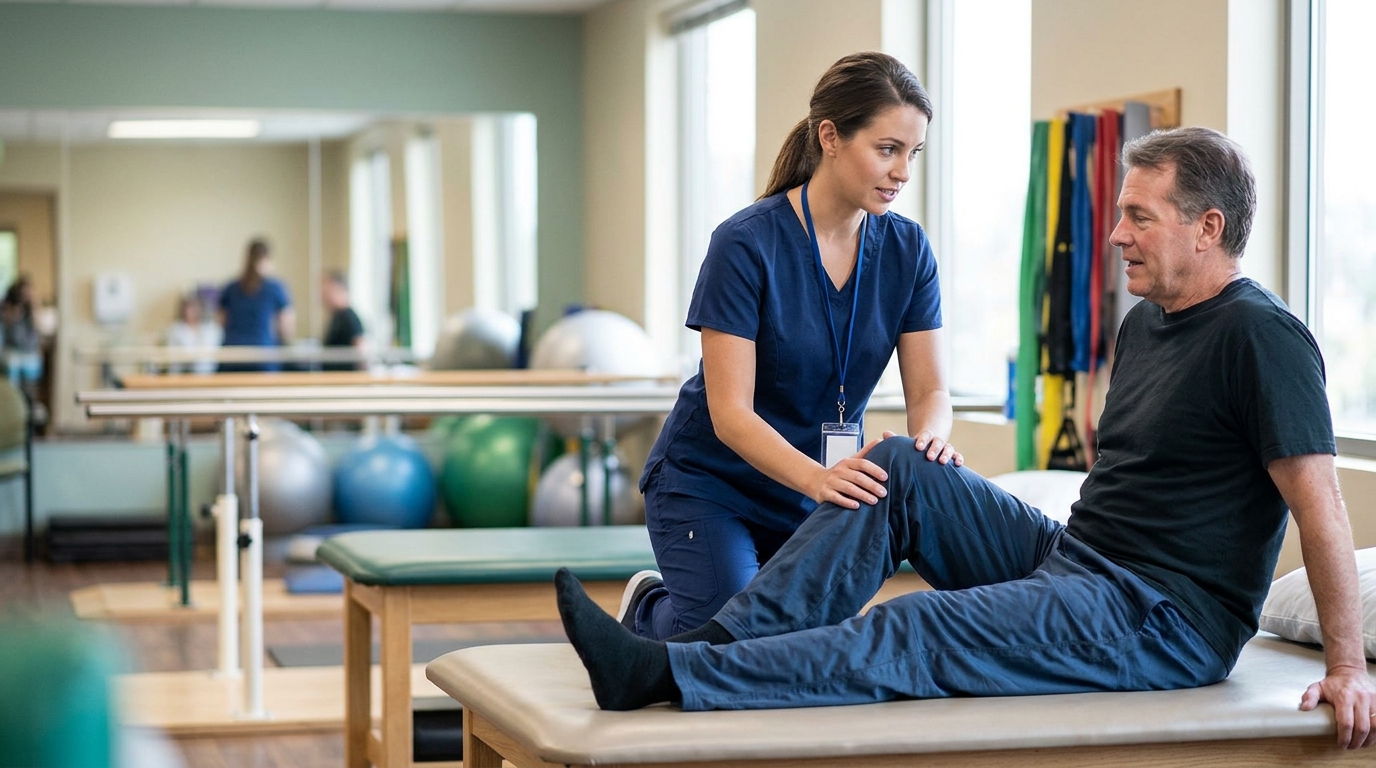
Physical therapist assistants (PTAs) work under the direction and supervision of physical therapists, helping patients recovering from injuries and illnesses regain movement and manage pain (U.S. Bureau of Labor Statistics, 2025). The job suits people who want patient contact all day, are comfortable kneeling, bending and lifting, and who can write accurate progress notes the supervising therapist relies on.
Entry takes about two years: every state requires an associate's degree from an accredited program plus a license or certification (U.S. Bureau of Labor Statistics, 2025).
What a Physical Therapist Assistant Actually Does
A clinic day usually starts before the first appointment. You read the supervising physical therapist's plan of care and the previous visit's progress notes, then set up the treatment area — parallel bars, resistance bands, hot packs, a gait belt — for the first arrival.
From there the day is patient after patient. You instruct, motivate, safeguard and assist patients as they practice exercises or functional activities (O*NET OnLine, U.S. Department of Labor), which in practice means counting repetitions, correcting a squat so a knee tracks properly, and keeping a hand on the gait belt while someone walks the length of the hallway for the first time since surgery. You treat patients using techniques such as massage and stretching, and you fit and teach the use of devices such as walkers (U.S. Bureau of Labor Statistics, 2025).
You also watch. PTAs observe patients before, during and after therapy, and observe them during treatment to compile and evaluate data on their responses and progress (U.S. Bureau of Labor Statistics, 2025; ONET OnLine). That observation becomes documentation: you record patients' progress and report the results of each treatment to the physical therapist, in person or through progress notes (U.S. Bureau of Labor Statistics, 2025; ONET OnLine).
Between visits you educate patients and family members about post-treatment care — how often to do the home exercise program, how to transfer safely from bed to chair, when to call the clinic (U.S. Bureau of Labor Statistics, 2025).
Signs This Career Might Fit You
- You like repeating the same instruction without losing patience: a patient three weeks post knee replacement may need the same cue about heel strike at every visit before the gait pattern changes. O*NET lists optimism and empathy among the top work styles for this occupation.
- You want hands-on contact, not a desk: you will be stretching a shoulder, applying massage, and steadying someone in the parallel bars for most of a shift (U.S. Bureau of Labor Statistics, 2025).
- You are comfortable carrying out someone else's plan: PTAs work under the direction and supervision of physical therapists, so you execute and report rather than diagnose or write the plan of care (U.S. Bureau of Labor Statistics, 2025).
- You write things down accurately: attention to detail is a listed work style, because your progress notes are how the supervising therapist decides whether to advance or modify treatment (O*NET OnLine; U.S. Bureau of Labor Statistics, 2025).
- Your hands are steady and precise: dexterity is a BLS-listed quality — you will be fitting a walker to a patient's height, taping, and positioning limbs for a stretch (U.S. Bureau of Labor Statistics, 2025).
- You can hold a conversation while working: O*NET's interest code for this occupation is SRC — Social, Realistic, Conventional — a mix of people work, physical work and following set procedures.
- Two years of school is the commitment you want: 84 percent of O*NET education survey respondents for this occupation said a new hire needs an associate's or other two-year degree.
Signs This Career Might Not Fit You
- You need to sit down during the day: PTAs are frequently on their feet and moving as they set up equipment and treat patients, and must kneel, stoop, bend and stand for long periods (U.S. Bureau of Labor Statistics, 2025).
- You have a history of back trouble, or do not want to risk one: because PTAs often lift and move patients, they are vulnerable to back injuries (U.S. Bureau of Labor Statistics, 2025).
- You want to set the treatment plan yourself: the evaluation, diagnosis and plan of care belong to the physical therapist; if you want that authority you are looking at a doctoral PT program, not a PTA associate's degree (U.S. Bureau of Labor Statistics, 2025).
- You dislike documentation: every treatment ends in a progress note reported back to the supervising therapist, and that paperwork does not go away on a busy day (U.S. Bureau of Labor Statistics, 2025; O*NET OnLine).
- Close physical contact with strangers bothers you: massage, stretching and guarding a patient during transfers mean hands-on work with people who may be in pain, sweating, or recently discharged from hospital (U.S. Bureau of Labor Statistics, 2025).
- You want to skip school and train on the job: all states require an associate's degree from an accredited program plus a license or certification, so there is no shortcut into the title (U.S. Bureau of Labor Statistics, 2025).
A Day in the Life
Shift structure varies by setting. Offices of physical, occupational and speech therapists and audiologists employ 44 percent of PTAs, hospitals 20 percent, home healthcare services 12 percent, nursing care facilities 10 percent and offices of physicians 6 percent (U.S. Bureau of Labor Statistics, 2025). The outpatient clinic day below is the most common pattern; home health PTAs drive between houses instead, and nursing facility PTAs work around meal and medication schedules.
| Time block | Typical task | Who you interact with |
|---|---|---|
| 7:00–7:30am | Read plans of care and previous progress notes; set up hot packs, bands and the parallel bars | Supervising physical therapist, front desk staff |
| 7:30–9:00am | First two or three patients: gait training with a gait belt, exercise progression, manual stretching | Early-shift patients, often pre-work adults |
| 9:00–11:00am | Back-to-back treatment slots; fit and adjust a walker, teach a home exercise program to a spouse | Patients, family members, PT aide |
| 11:00am–12:00pm | Post-surgical patients; report an unexpected swelling or pain response to the therapist mid-session | Supervising physical therapist |
| 12:00–1:00pm | Lunch, caught up with progress notes and insurance documentation | Front desk, billing staff |
| 1:00–3:30pm | Afternoon caseload: balance work with older adults, strengthening circuits, massage | Patients, other PTAs |
| 3:30–5:30pm | After-school and after-work patients, including youth sports injuries | Teen athletes, parents, coaches by phone |
| 5:30–6:00pm | Finish documentation, flag patients who are not progressing, restock linens and clean equipment | Supervising physical therapist, closing staff |
How to Get Started
- Shadow a working PTA and finish program prerequisites (1–6 months). Call outpatient clinics and ask about observation hours; many accredited programs require documented hours plus prerequisite coursework in biology, algebra or English before you can apply. Confirm the minimum age of 18 that some states require for licensure (U.S. Bureau of Labor Statistics, 2025).
- Enroll in an accredited PTA associate's degree program (about 2 years). Programs include coursework in anatomy, physiology and kinesiology plus supervised clinical work, and all states require this degree for entry (U.S. Bureau of Labor Statistics, 2025).
- Complete clinical rotations (typically the final terms of the program). You treat real caseloads under a licensed therapist's supervision — this is where employers often meet you first, and clinical sites regularly hire their own students.
- Register for the National Physical Therapy Examination (set up in your final year). The NPTE is administered by the Federation of State Boards of Physical Therapy and you must pass it to be licensed as a PTA in the United States; your school initiates the FSBPT account process by the end of your first year and validates graduation readiness no more than 150 days before graduation (American Physical Therapy Association).
- Pass the NPTE and any state jurisprudence exam (2–4 months around graduation). Licensure typically requires graduation from an accredited program and passing a qualifying exam; some states also require an exam on state PTA practice laws and a background check (U.S. Bureau of Labor Statistics, 2025). Rules differ by state — check your state's physical therapy board.
- Apply for entry-level Physical Therapist Assistant roles (1–3 months). Target the settings that hire most: outpatient therapy offices, hospitals, home healthcare services and nursing care facilities (U.S. Bureau of Labor Statistics, 2025). Pay is usually hourly or salaried and varies by setting and state — look up current figures in the BLS Occupational Employment and Wage Statistics data for physical therapist assistants.
- Build competence in your first year or two on the job. O*NET places this occupation in Job Zone Three, medium preparation needed, typically requiring one or two years of combined on-the-job and informal training.
Frequently asked questions
How long does it take to become a physical therapist assistant?
About two years for the associate's degree from an accredited program, which includes anatomy, physiology and kinesiology coursework plus supervised clinical work (U.S. Bureau of Labor Statistics, 2025), then a few weeks to a few months to pass the National Physical Therapy Examination and obtain your state license.
Do you need a license to work as a PTA?
Yes. All states require physical therapist assistants to be licensed or certified. Licensure typically requires graduating from an accredited program and passing a qualifying exam; some states add an exam on state PTA practice laws, a background check, and a minimum age of 18 (U.S. Bureau of Labor Statistics, 2025).
What is the difference between a physical therapist and a PTA?
Physical therapist assistants work under the direction and supervision of physical therapists (U.S. Bureau of Labor Statistics, 2025). The therapist evaluates and writes the plan of care; you carry out treatments, observe responses, and report results back through progress notes. The PTA route is a two-year associate's degree rather than a doctoral program.
Is physical therapist assistant a growing field?
Employment of physical therapist assistants and aides is projected to grow 17 percent from 2025 to 2035, much faster than average, with about 24,900 openings projected each year, largely to replace workers who change occupations or leave the labor force (U.S. Bureau of Labor Statistics, 2025).
Is the job physically demanding?
Yes. BLS lists physical stamina as an important quality, including kneeling, stooping, bending and standing for long periods, and notes PTAs are vulnerable to back injuries because they often lift and move patients (U.S. Bureau of Labor Statistics, 2025). Learn safe transfer technique early and use a gait belt.
Sources
- U.S. Bureau of Labor Statistics — Physical Therapist Assistants and Aides : Occupational Outlook Handbook (2025)
- O*NET OnLine (U.S. Department of Labor) — 31-2021.00 - Physical Therapist Assistants