Six Sigma Certification Guide: What You Need to Know
A practical look at belt levels, what ASQ and IASSC each ask for, and how to turn one DMAIC project into proof an employer can actually check.
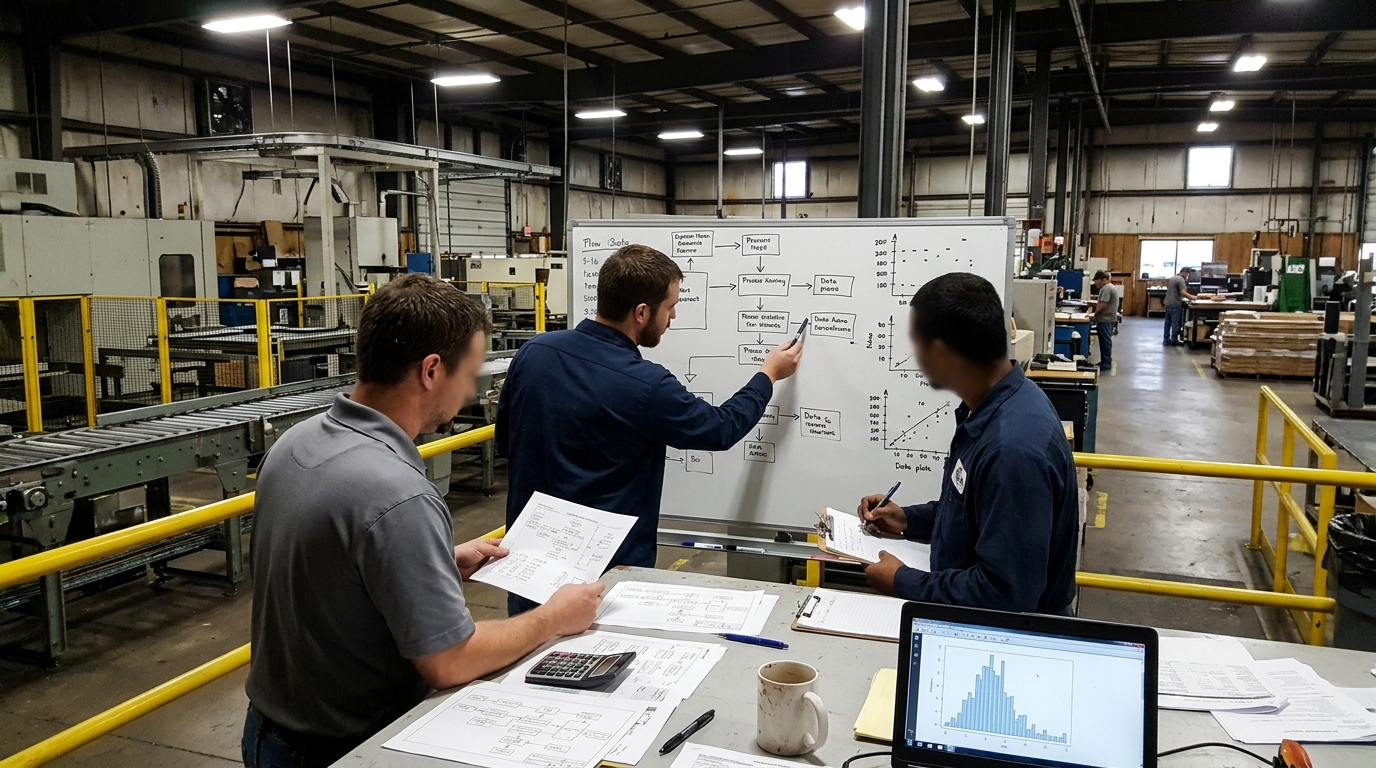
Six Sigma certification is a structured credential in process improvement, built around the DMAIC cycle (define, measure, analyse, improve, control) and awarded in belt levels. The five recognised levels run from White and Yellow through Green and Black to Master Black Belt, with each level taking on a bigger role in leading projects (SixSigma.us). Which body you certify with matters more than most people expect: ASQ, IASSC and the Council for Six Sigma Certification set different rules on experience, project evidence and renewal.
The method itself dates to 1986, when engineer Bill Smith developed it at Motorola (Wikipedia). It is still used heavily in manufacturing, logistics, healthcare operations and financial back-office work.
Why This Skill Matters for Your Career
Six Sigma is a hiring filter in roles where reducing variation and defects is the job, not a side task.
Quality engineer. A Green or Black Belt is a common requirement on these postings. The work looks like running a gauge R&R study to find out whether your measurement system is the real source of variation, building X-bar and R control charts in Minitab, and writing the control plan that keeps a fix in place after the project team disbands.
Continuous improvement or operational excellence manager. Here you lead DMAIC projects rather than support them: mapping a value stream for an order-to-cash process, running a Pareto analysis on scrap codes to decide which three defect types to attack first, then facilitating a kaizen event with the line operators who actually have to live with the change.
Quality control inspector is a related entry route. The U.S. Bureau of Labor Statistics publishes 2025 median pay, the 2025–35 job outlook and annual openings, and the typical entry-level education and on-the-job training for this occupation — look it up in the Occupational Outlook Handbook rather than relying on figures quoted second-hand, as they are revised. Pay in all of these roles is normally a salary set by the employer, with belt level treated as one input among experience, industry and location.
Six Sigma also travels. Hospitals use it on patient throughput, banks on loan processing errors, distribution centres on pick accuracy. The statistical core is the same.
Skill-Building Roadmap
- Read the Body of Knowledge first (Week 1). ASQ publishes the Certified Six Sigma Green Belt and Black Belt Bodies of Knowledge on its certification pages, and IASSC publishes its Lean Six Sigma Body of Knowledge, both free to download. Print the one matching your target belt and treat it as the syllabus.
- Learn the DMAIC cycle end to end (Weeks 2–4). Work through one phase at a time and write your own one-page summary of the tools used in each: SIPOC and project charter in Define, data collection plan and process capability in Measure, hypothesis tests and root cause analysis in Analyse.
- Build the statistics you are missing (Weeks 4–8). Descriptive statistics, normal distribution, t-tests, ANOVA, regression and control charts. Practise each in Excel first, then repeat the same dataset in Minitab so you can speak to both.
- Choose your certifying body before you buy training (Week 8). ASQ's Green Belt has an experience requirement and its Black Belt requires documented projects plus a signed project affidavit; IASSC's exams have no prerequisites and no recertification (ASQ; Six Sigma DSI). Pick based on whether your employer will sign off a project.
- Run or join a real project (Months 3–9). Scope something small enough to finish: one defect type, one process step, one measurable output. Collect baseline data before you change anything — without it you have no result to report.
- Sit the exam (Months 6–12). ASQ's Black Belt is delivered by computer and, at select locations, in a paper-and-pencil format (ASQ). ASQ's Green Belt exam format and passing score, and IASSC's Green Belt format and passing threshold, are published by those bodies — check the current spec before booking.
- Document the project and diarise renewal (Month 12 onward). ASQ's Black Belt runs on a recertification cycle (Umbrex); set a calendar reminder the week you pass.
Tools, Courses, and Certifications to Consider
| Credential or tool | Provider | Cost | Time commitment |
|---|---|---|---|
| Certified Six Sigma Green Belt (CSSGB) | ASQ | Exam fee published on ASQ's certification page, with a members/non-members structure (summarised by ProcessExam.com) | Plan 8–12 weeks of part-time study; experience requirement applies (ClavePrep summary of ASQ) |
| Certified Six Sigma Black Belt (CSSBB) | ASQ | Exam fee plus a lower retake fee, both listed on ASQ's certification page (ASQ) | 4–9 months including the required project work and signed affidavit (ASQ) |
| Certified Lean Six Sigma Yellow Belt (ICYB) | IASSC, exam voucher sold by PeopleCert | Voucher price listed by PeopleCert | 2–4 weeks of self-study; no prerequisites |
| Certified Lean Six Sigma Black Belt (ICBB) | IASSC, exam voucher sold by PeopleCert | Voucher price listed by PeopleCert | 3–6 months; no project or experience prerequisite, no recertification (Six Sigma DSI) |
| Belt-level exams (White through Black) | Council for Six Sigma Certification (CSSC) | Exam pricing published by CSSC (summarised by AIR Academy) | Self-paced |
| Minitab Statistical Software | Minitab | Commercial licence; check Minitab's site for current pricing and trial options | A weekend to get productive if you already know the statistics |
Two cost notes. Commercial Lean Six Sigma training is priced separately from the exam and typically adds a significant amount on top of the exam fee (AIR Academy). And ASQ's retake fee is lower than the initial exam fee (ASQ), which is worth knowing before you panic-book a second training course.
How to Prove This Skill to Employers
- Write a one-page DMAIC storyboard for a completed project: problem statement, baseline measurement, root cause, the change you made, and the post-change data. Bring it to interviews as a printout.
- Cite the measurable outcome in units the business uses — defects per unit before and after, cycle time in hours, scrap in kilograms or dollars, first-pass yield percentage. "Improved quality" tells a hiring manager nothing.
- Get the ASQ project affidavit signed if you are going for the Black Belt. ASQ requires completed projects evidenced by affidavit (ASQ), and that signature is independent confirmation a manager made.
- List the credential precisely on your resume, with the awarding body, the exact title and your certification number — for example "ASQ Certified Six Sigma Green Belt (CSSGB)" rather than "Six Sigma certified." Recruiters screen for the body as well as the belt.
- Show the analysis artefacts. A control chart, a Pareto chart, a capability study and a gauge R&R output from Minitab or Excel demonstrate you did the statistics rather than attended the class.
- Volunteer to run an improvement project in your current role before you have the belt. A documented internal project plus a Yellow Belt is more convincing than a Black Belt with no project behind it.
Common Mistakes to Avoid
- Buying the cheapest belt available and assuming all belts are equal. Fix: compare the exam specifications side by side — ASQ requires experience and project evidence, IASSC does not (ASQ; Six Sigma DSI) — and pick the one your target industry recognises.
- Skipping the statistics and memorising tool names. Fix: work every hypothesis test and control chart in the Body of Knowledge by hand or in software at least once; the exams test application, not vocabulary.
- Starting the project without baseline data. Fix: measure the current process for a defined period before making any change, or you will have nothing to compare against at the end.
- Budgeting only for the exam. Fix: price the training separately, since commercial Lean Six Sigma courses add substantially to the exam fee (AIR Academy).
- Letting an ASQ certification lapse. Fix: ASQ's Black Belt runs on a recertification cycle (Umbrex) — log your recertification units as you earn them instead of scrambling at the deadline.
- Booking the wrong exam format. Fix: confirm whether you are sitting the computer-delivered version or the paper-and-pencil version offered at select locations (ASQ), since the logistics and scheduling differ.
Frequently asked questions
Should I start at Yellow Belt or go straight to Green Belt?
Yellow Belt is a reasonable first step if you have never worked on a structured improvement project, because it covers the vocabulary and the DMAIC sequence without demanding statistical depth. Green Belt is the level most quality and continuous improvement job postings actually ask for, so if you already handle data at work, go there directly. Note that ASQ's Green Belt carries an experience requirement, while IASSC's exams have no prerequisites.
Is ASQ or IASSC certification better?
They test similar knowledge but work differently as credentials. ASQ requires documented experience and, at Black Belt, completed projects evidenced by a signed affidavit, and its certifications must be recertified; IASSC has no prerequisites and no recertification requirement (ASQ; Six Sigma DSI). If your employer will sign off a project, ASQ carries more weight; if you need a credential independently and quickly, IASSC is the easier route.
Can I get certified without a project at work?
For IASSC and Council for Six Sigma Certification exams, yes — they assess knowledge rather than project evidence. ASQ's Black Belt specifically requires completed projects, so you cannot bypass that. If your current role has no obvious project, look at a repeatable administrative process such as invoice errors or onboarding delays, which generate the defect data you need.
How long does the whole process take?
A Yellow Belt is realistically a few weeks of self-study. A Green Belt usually takes two to three months of part-time preparation, and a Black Belt with a real project attached commonly runs six to twelve months because the project timeline, not the exam, sets the pace. Build your schedule backwards from when the project data will be complete.
Sources
- U.S. Bureau of Labor Statistics — Quality Control Inspectors : Occupational Outlook Handbook (2025)
- ASQ (American Society for Quality) — Six Sigma Black Belt Certification CSSBB