Physical Therapist vs Occupational Therapist: Which One Fits You Better?
Both need a state license and an exam, and their May 2025 median wages sat within a few thousand dollars — the real split is what each one actually treats.
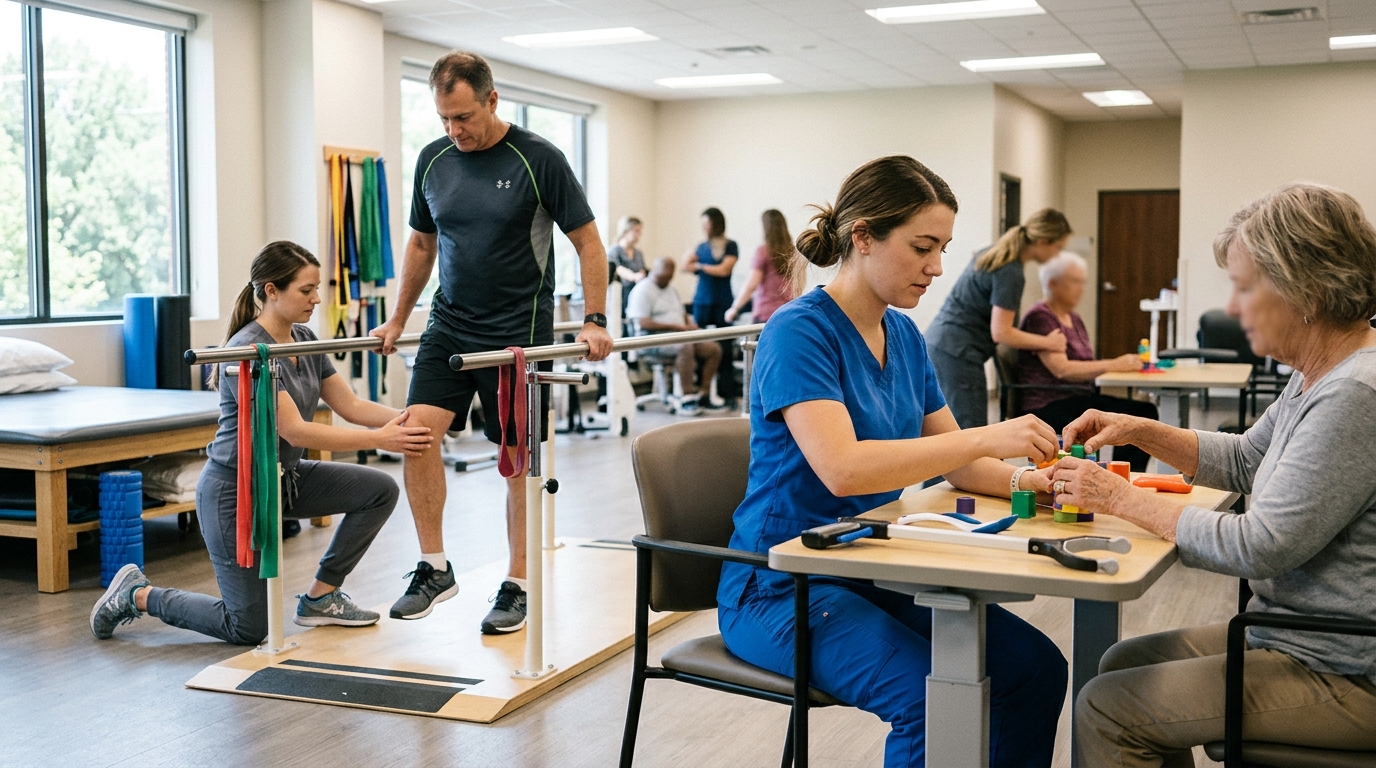
Physical therapists treat movement problems — strength, range of motion, balance, walking. Occupational therapists treat participation in daily activities — dressing, bathing, cooking, handwriting, returning to a job. The two overlap in setting, caseload and licensing, but they diverge in the entry degree (a 3-year Doctor of Physical Therapy versus a 2-to-3-year master's) and in what a treatment session looks like.
If you want to rebuild how a body moves, look at physical therapy. If you want to rebuild how a person gets through their day, look at occupational therapy.
Physical Therapist vs Occupational Therapist at a Glance
Both careers are measured here on the same metrics, in the same order. Pay figures are national medians and vary by state, setting and employer — check the U.S. Bureau of Labor Statistics Occupational Employment and Wage Statistics pages for current rates in your state before you commit to a program.
| Metric | Physical Therapist | Occupational Therapist |
|---|---|---|
| Typical entry education | Doctor of Physical Therapy (DPT) from an accredited program; DPT programs typically last 3 years (U.S. Bureau of Labor Statistics, August 2026). Among ONET respondents, 47% said a doctoral degree is required for new hires, 38% a master's, 8% a bachelor's (ONET OnLine, 2026) | Master's degree in occupational therapy; master's programs usually take 2 to 3 years (U.S. Bureau of Labor Statistics, August 2026). Among ONET respondents, 86% said a master's is required for new hires and 14% a bachelor's (ONET OnLine, 2026) |
| Median pay | $102,760 per year, May 2025 (U.S. Bureau of Labor Statistics, 2025) | $100,330 per year, May 2025 (U.S. Bureau of Labor Statistics, 2025) |
| Typical hours | Most work full time, usually during normal business hours; some work evenings or weekends (U.S. Bureau of Labor Statistics, August 2026) | Most work full time, but part-time work is common; may work nights or weekends to accommodate clients' schedules (U.S. Bureau of Labor Statistics, August 2026) |
| Physical demands | Much of the day on their feet working with patients; must often lift and move patients, leaving them vulnerable to back injuries (U.S. Bureau of Labor Statistics, August 2026) | Stand for long periods and may need to lift or move clients or heavy equipment; one of the highest rates of injuries and illnesses of all occupations (U.S. Bureau of Labor Statistics, August 2026) |
| Entry barrier (licensing) | All states require licensure, which includes passing a qualifying exam (U.S. Bureau of Labor Statistics, August 2026) | All states require licensure; passing the qualifying exam allows use of the title Occupational Therapist Registered (OTR) (U.S. Bureau of Labor Statistics, August 2026) |
| Common first job title | Acute Care PT, Outpatient Physical Therapist, Inpatient Physical Therapist, Home Care Physical Therapist, Pediatric Physical Therapist (O*NET OnLine, 2026) | Occupational Therapist (OT), Registered Occupational Therapist (OTR), Early Intervention Occupational Therapist, Home Health Occupational Therapist, Pediatric Occupational Therapist (O*NET OnLine, 2026) |
| Common work settings | Private offices and clinics, hospitals, patients' homes, nursing homes (U.S. Bureau of Labor Statistics, August 2026) | Hospitals, schools, outpatient clinics (U.S. Bureau of Labor Statistics, August 2026) |
| Size of the field | About 283,700 jobs in 2025 (U.S. Bureau of Labor Statistics, 2025) | About 169,600 jobs in 2025 (U.S. Bureau of Labor Statistics, 2025) |
| Projected growth | 12 percent, 2025 to 2035, much faster than average (U.S. Bureau of Labor Statistics, 2025–2035) | 15 percent, 2025 to 2035, much faster than average (U.S. Bureau of Labor Statistics, 2025–2035) |
Where These Careers Overlap
Both roles begin with an evaluation: you measure what a person can and cannot do, write measurable goals, and document progress in the electronic health record so the plan of care survives an insurance review. Both involve teaching more than treating — a physical therapist walks a patient through a home exercise program after rotator cuff repair, an occupational therapist walks a spouse through a safe shower transfer — and both spend part of every day coaching the family members who will carry out the plan after discharge.
Both move people. Transfers from bed to wheelchair, gait belts and mechanical lifts are routine in each job, which is why physical therapists are vulnerable to back injuries and occupational therapists have one of the highest injury and illness rates of all occupations (U.S. Bureau of Labor Statistics, August 2026).
Licensing is parallel too: every state licenses both, and both require a qualifying exam. Settings overlap heavily — hospitals, outpatient clinics, home health and pediatrics — so you will often share a gym and a caseload with your counterpart.
Where They Diverge
The biggest practical divergence is the unit of treatment. A physical therapist treats the movement itself; an occupational therapist treats the activity the movement is for. That single difference changes what you look at, what you measure, and what a good day feels like.
Take one patient, three weeks after a total knee replacement. The physical therapist's session is about the joint and the walking: measuring knee flexion with a goniometer, grading quadriceps strength, progressing from a rolling walker to a cane, drilling stair negotiation and sit-to-stand until the patient clears a timed walk test. Success is degrees of motion and distance covered.
The occupational therapist sees the same patient and asks what the day requires. Can she put on socks without bending past the safe range, or does she need a sock aid and a long-handled reacher? Can she get over the tub wall, or does the bathroom need a tub bench and grab bars? Can she stand long enough to cook dinner, and what would make that possible — a perching stool, a rolling cart? Success is a load of laundry done alone.
That focus also shapes where the jobs sit. Occupational therapists commonly work in schools and early intervention; physical therapists more often work in private clinics and nursing homes (U.S. Bureau of Labor Statistics, August 2026).
Which Path Fits You Better
Column A is physical therapy. Column B is occupational therapy. Tick every statement that is true of you, and count. If you check more boxes in column A, start looking at accredited Doctor of Physical Therapy programs; if column B, look at master's programs in occupational therapy.
- Entry degree. A: you are willing to commit to a 3-year doctoral program and the title DPT. B: you would rather finish entry education in a 2-to-3-year master's and start practising sooner.
- Licensing exam and credential. A: a single state licence and qualifying exam is the credential you want on the wall. B: you want to earn the Occupational Therapist Registered (OTR) title and use those letters professionally.
- Daily task focus. A: you want to measure knee flexion with a goniometer and progress a patient from walker to cane. B: you want to decide whether a sock aid, a tub bench or a perching stool solves the problem.
- Pay. A or B: the May 2025 medians were $102,760 for physical therapists and $100,330 for occupational therapists (U.S. Bureau of Labor Statistics, 2025), so leave this box blank unless a specific local job offer tips it.
- Hours. A: you want a predictable weekday clinic schedule, accepting that some roles include evenings or weekends. B: part-time or split hours around clients' evening and weekend availability would actually suit your life.
- Work settings. A: hospitals, outpatient orthopaedic clinics and nursing homes sound like where you belong. B: a school district caseload or early intervention visits in family homes appeals more.
- Physical demands. A or B: you can accept being on your feet most of the shift and lifting patients with a gait belt or mechanical lift — if that is a hard no, neither column works, because both carry documented injury risk.
- Size of the field. A: a larger pool of roughly 283,700 jobs in 2025 means more postings to choose from in a given metro area (U.S. Bureau of Labor Statistics, 2025). B: a smaller field of about 169,600 jobs in 2025 is fine with you if the work fits.
- Projected growth. A: 12 percent growth from 2025 to 2035 is plenty. B: the slightly faster 15 percent projection for occupational therapists over the same period matters to you (U.S. Bureau of Labor Statistics, 2025–2035).
- First job title. A: Acute Care PT or Outpatient Physical Therapist reads like your future business card. B: Early Intervention Occupational Therapist or Home Health Occupational Therapist does.
Before you decide, shadow one of each on the same unit. Watching a PT and an OT treat the same post-surgical patient within an hour of each other settles the question faster than any list.
Frequently asked questions
Do I need a doctorate to become a physical therapist?
Physical therapists entering the occupation need a Doctor of Physical Therapy degree from an accredited program, and DPT programs typically last 3 years (U.S. Bureau of Labor Statistics, August 2026). Among O*NET respondents, 47% said a doctoral degree is required for new hires (O*NET OnLine, 2026).
Which one has better job prospects?
Occupational therapist employment is projected to grow 15 percent from 2025 to 2035, and physical therapist employment 12 percent over the same period — both much faster than average (U.S. Bureau of Labor Statistics, 2025–2035). Physical therapy is the larger field, with about 283,700 jobs in 2025.
Is occupational therapy easier on the body?
No. Occupational therapists have one of the highest rates of injuries and illnesses of all occupations because they may lift and move clients or heavy equipment, and they stand for long periods (U.S. Bureau of Labor Statistics, August 2026).
Can I work part time as an occupational therapist?
Most occupational therapists work full time, but part-time work is common, and some work nights or weekends to accommodate clients' schedules (U.S. Bureau of Labor Statistics, August 2026). Availability of part-time roles varies by employer, setting and state.
Sources
- U.S. Bureau of Labor Statistics — Physical Therapists : Occupational Outlook Handbook (2025)
- U.S. Bureau of Labor Statistics — Occupational Therapists : Occupational Outlook Handbook (2025)