Is a Career in Veterinary Technology Right for You?
From restraining a frightened cat for radiographs to monitoring anesthesia during surgery, here is what the work asks of you day to day.
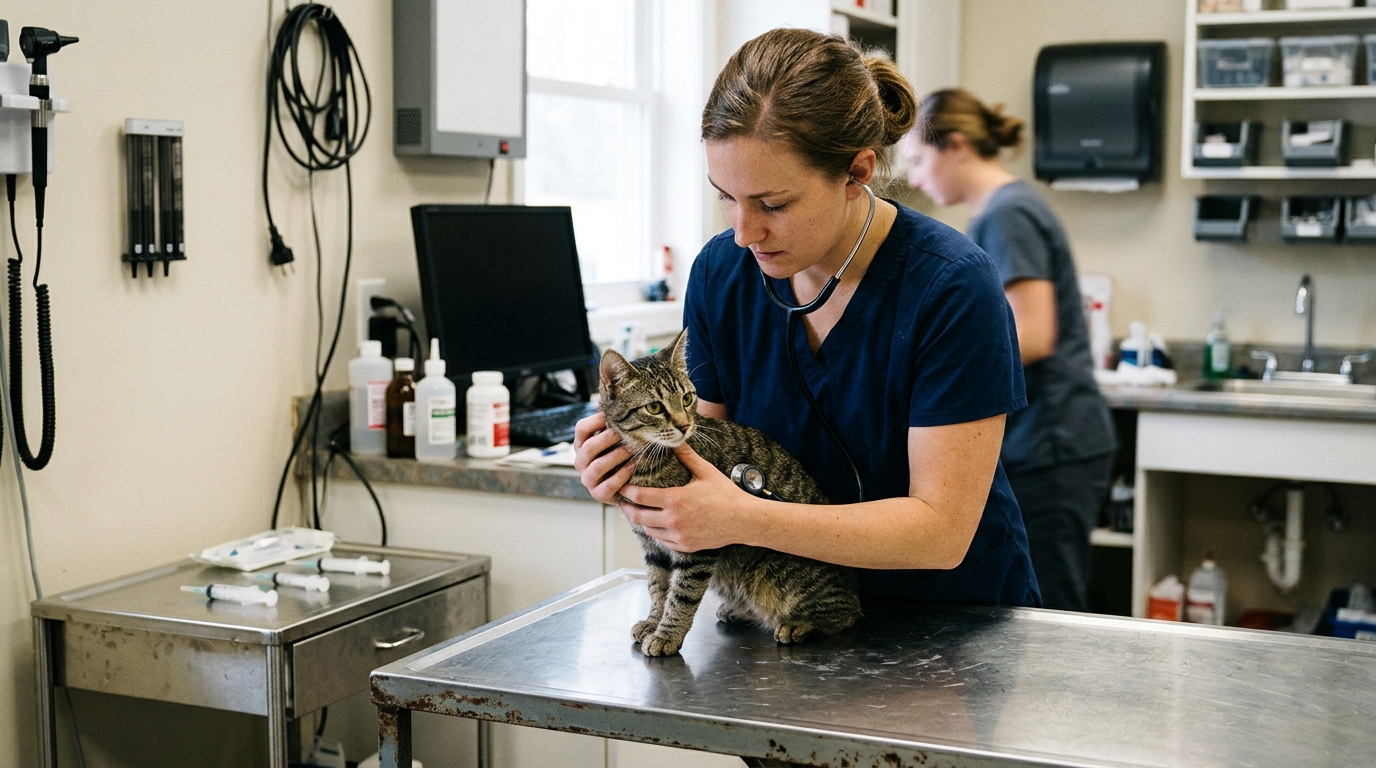
Veterinary technology suits people who want hands-on medical work with animals and can handle the physical and emotional side of it: restraining scared patients, running blood counts, monitoring anesthesia, and sometimes assisting with euthanasia. Most roles require an AVMA-accredited associate's or bachelor's degree and a passing score on the Veterinary Technician National Examination (VTNE), plus state credentialing (NAVTA; U.S. Bureau of Labor Statistics, 2025).
It fits you if you like structured clinical tasks and detail work more than you mind early starts, weekend shifts, and the real risk of bites and scratches.
What a Veterinary Technician Actually Does
You arrive before the first appointment, read overnight notes on hospitalized patients, and start treatment rounds: temperature, pulse and respiration on each patient, then the medications, vaccines and treatments the veterinarian ordered. By mid-morning you are in the lab running a urinalysis and a complete blood count, then positioning a limping retriever for x-rays while a colleague holds the hind end.
Before a scheduled surgery you prepare the animal and the instruments, clip and scrub the surgical site, then administer anesthesia under the direction of a veterinarian and monitor the animal's responses so dosages can be adjusted — ONET lists that monitoring task as a sample duty for the occupation (ONET OnLine).
Afternoons swing back to appointments. You restrain animals during exams, draw blood, place catheters, give injections, observe behavior and condition for anything the veterinarian should see, and record case histories in the practice software. Discharges end with client education: how to split a pill, what a surgical site should look like on day three, when to call back.
NAVTA describes the role as the veterinarian's nurse, laboratory technician, radiography technician, anesthetist, surgical nurse and client educator — you move between those six jobs in a single shift. Bathing, clipping and grooming patients also appear in the duties the U.S. Bureau of Labor Statistics lists for the occupation (2025), and so does providing nursing care and emergency first aid.
Signs This Career Might Fit You
- You hold steady when an animal panics: a cat that has already scratched one person still needs to be restrained for a blood draw, and O*NET lists Stress Tolerance and Self-Control among the work styles for this occupation.
- You like precise manual work: placing an IV catheter in a small-breed dog or positioning a patient for a diagnostic x-ray rewards manual dexterity, which BLS names as an important quality (2025).
- You check numbers twice: anesthetic dosages and monitored responses have to be read, recorded and reported accurately, and Attention to Detail and Cautiousness are both listed O*NET work styles.
- You are comfortable with physical work: BLS lists physical strength — the ability to manage and lift animals — as an important quality (2025), which in practice means lifting a sedated labrador onto a table.
- You can explain medical instructions to upset people: discharging a post-surgical patient means walking an owner through medication timing while they are still worried, and NAVTA names client educator as part of the role.
- Laboratory and diagnostic tasks interest you as much as the animals do: O*NET gives the occupation the interest code RIC — Realistic, Investigative, Conventional — with Animal Service as a specific interest area.
- You work well inside a defined scope: you administer anesthesia and treatments under the direction of a veterinarian, not on your own judgment, and Cooperation and Integrity are listed work styles.
Signs This Career Might Not Fit You
- You need predictable hours: BLS notes that workers may have to work evenings, weekends, or holidays (2025), and emergency hospitals staff overnight shifts year-round.
- You cannot accept physical risk: veterinary technologists and technicians have one of the highest rates of injuries and illnesses of all occupations, including bites, scratches, or kicks from scared or aggressive animals (U.S. Bureau of Labor Statistics, 2025).
- You want desk-based work: the day is spent standing, restraining, lifting and cleaning, with intervals of hair, urine, anal glands and surgical prep rather than screen time.
- Grief would follow you home: BLS describes the work as physically or emotionally demanding, and notes that workers may witness abused animals or help euthanize sick, injured, or unwanted animals (2025).
- You want to diagnose and prescribe: a technician administers anesthesia and medications under the direction of a veterinarian; diagnosis and surgery belong to the DVM.
- Interrupted work bothers you: a morning treatment round regularly stops for a walk-in emergency, and you restart the round after the patient is stabilized.
A Day in the Life
A day shift in a companion-animal general practice. Emergency and specialty hospitals run the same tasks across evening, overnight, weekend and holiday shifts (U.S. Bureau of Labor Statistics, 2025).
| Time block | Typical task | Who you interact with |
|---|---|---|
| 7:00-8:00am | Read overnight notes, take temperature, pulse and respiration on hospitalized patients, give ordered medications | Overnight technician handing over, kennel assistant |
| 8:00-10:00am | Restrain animals during exams, draw blood, place catheters, triage walk-ins | Veterinarian, veterinary assistants, clients in exam rooms |
| 10:00am-12:00pm | Run urinalyses and complete blood counts, take and review x-rays, log results in the record | Veterinarian reading results, outside reference lab courier |
| 12:00-2:00pm | Prepare animals and instruments for surgery, clip and scrub, administer anesthesia and monitor responses so dosages can be adjusted | Surgeon, surgical assistant |
| 2:00-4:00pm | Post-op recovery monitoring, bathing, clipping and grooming patients, nail trims, dental charting | Recovering patients, practice manager scheduling recheck visits |
| 4:00-6:00pm | Discharge appointments and client education, record case histories, restock crash cart and anesthesia machine | Owners collecting patients, incoming evening technician |
How to Get Started
- Spend 1-3 months in an animal-care role or volunteer placement — kennel attendant, veterinary assistant, or shelter volunteer — before you commit to tuition. You will find out quickly whether restraint, cleaning and euthanasia days are tolerable for you.
- Enroll in an AVMA-accredited program. A 2-year associate's degree leads to the veterinary technician title; a 4-year bachelor's degree leads to veterinary technologist (U.S. Bureau of Labor Statistics, 2025). NAVTA notes that most credentialed technicians are graduates of an AVMA-accredited associate's or bachelor's program, and that some states provide alternate routes to credentialing — check your own state board before you assume either path.
- Complete the clinical rotations or externship built into the program, usually in the final two semesters. O*NET classifies the occupation in Job Zone Three, describing such jobs as usually needing one or two years of training that combines on-the-job experience with informal training alongside experienced workers.
- Study for and sit the Veterinary Technician National Examination (VTNE). Most candidates give it 2-4 months of structured review alongside the end of their program; NAVTA names the VTNE as the exam credentialed technicians have passed.
- Apply for state credentialing. BLS notes that technologists and technicians typically must pass a credentialing exam and become registered, licensed, or certified depending on the state (2025), so the title you hold — RVT, LVT or CVT — depends on where you work. Processing commonly takes several weeks.
- Take an entry-level credentialed position: veterinary technician in general practice, or technician in an emergency and critical care hospital if you want overnight volume. Expect the first 3-6 months to be heavy on supervised anesthesia and radiography cases.
- After several years, consider specialty certification. NAVTA states that a specialist has met base credentialing requirements, spends about 75% of their time on a specific task, and has passed a specialist certification exam administered by a Specialist Academy, with eleven academies currently offering specialty certification.
Frequently asked questions
How long does it take to become a veterinary technician?
A technician credential typically follows a 2-year associate's degree; the technologist title typically follows a 4-year bachelor's (U.S. Bureau of Labor Statistics, 2025). Add a few months for VTNE preparation and state credentialing paperwork, so most people are working within roughly 2.5 to 4.5 years from starting school.
What is the difference between a veterinary technician and a veterinary technologist?
Education length. BLS states technicians usually need a 2-year associate's degree and technologists usually need a 4-year bachelor's degree (2025). Both typically pass a credentialing exam and become registered, licensed, or certified depending on the state, and both perform nursing, laboratory, radiography and anesthesia tasks.
How much do veterinary technicians earn?
Pay is usually hourly, with differentials common for overnight, weekend and holiday shifts and emergency work. The U.S. Bureau of Labor Statistics publishes a median annual wage for veterinary technologists and technicians (May 2025) — look it up in the BLS Occupational Outlook Handbook for the current figure, then compare it with state-level data.
Where do veterinary technicians work besides clinics?
The veterinary services industry is the largest employer group for the occupation (U.S. Bureau of Labor Statistics, 2025). Other settings include research laboratories, animal shelters, zoos and wildlife facilities, teaching hospitals, and emergency and specialty referral centers that staff technicians overnight.
Is veterinary technology a dangerous job?
It carries real physical risk. BLS reports that veterinary technologists and technicians have one of the highest rates of injuries and illnesses of all occupations, including bites, scratches, or kicks from scared or aggressive animals (2025). Restraint training, muzzles, sedation protocols and gloves reduce but do not remove it.
Sources
- U.S. Bureau of Labor Statistics — Veterinary Technologists and Technicians : Occupational Outlook Handbook (2025)
- O*NET OnLine — 29-2056.00 - Veterinary Technologists and Technicians