How Much Does a Phlebotomist Make?
Phlebotomy pay is set by certification, work setting and state more than by job title, and the national median hides wide gaps between them.
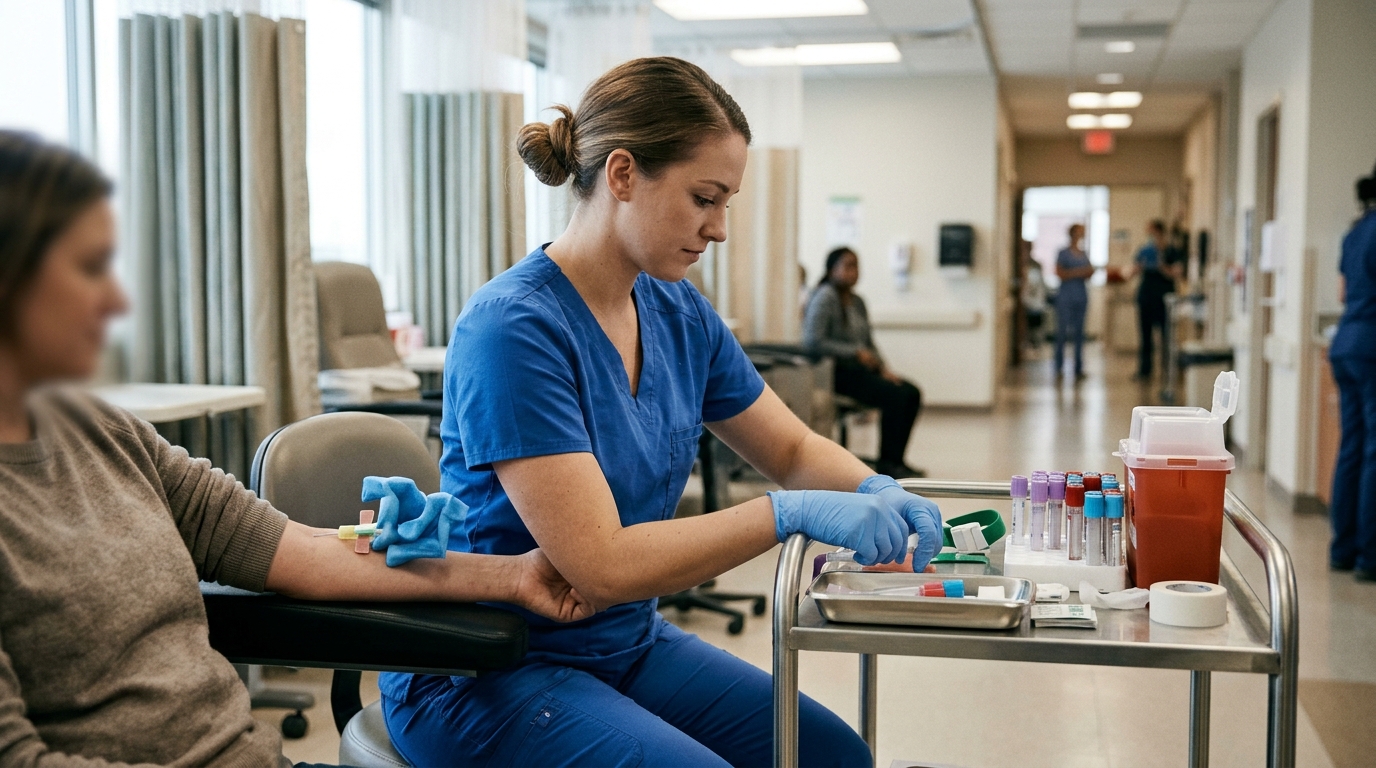
The median annual wage for phlebotomists was $45,230 in May 2025 (U.S. Bureau of Labor Statistics, 2025-05). Median means the midpoint: half of phlebotomists earned more than that and half earned less. It is not the same as the average, and it is not what a first-week trainee at a plasma center earns.
What you actually take home depends on whether you hold a certification, whether you work in a hospital or an outpatient draw station, and which state you work in — California is reported as the top-paying state and Louisiana the lowest-paying, both using BLS May 2025 wage data (PhleboPrep, 2025-05).
What the Typical Phlebotomist Earns
The median annual wage for phlebotomists was $45,230 in May 2025 (U.S. Bureau of Labor Statistics, 2025-05). Every reference to "median" in this guide means that midpoint figure — half of workers in the occupation earned more, half earned less. Where a source reports an average (mean) instead, that number is pulled upward by the highest earners and usually sits above the median, so the two are not interchangeable.
BLS publishes a full percentile spread alongside that median in its Occupational Employment and Wage Statistics (OEWS) release, including what the lowest-paid 10% and the highest-paid 10% earn (reported from BLS data by Dreambound, 2024-05). Those two end-point figures matter more than the median if you are just starting or deciding whether to stay in the role long term, and they change with each annual OEWS release — look them up directly on the BLS page for phlebotomists, or on the O\NET OnLine profile for the occupation (O\NET OnLine, U.S. Department of Labor, 2025), rather than relying on a number quoted in a job ad.
Treat $45,230 as a national anchor only. It blends a plasma-center trainee in the lowest-paying state with a hospital night-shift phlebotomist in the highest-paying one, and those two are not close. California is reported as the top-paying state and Louisiana as the lowest-paying, both based on BLS May 2025 wage data (PhleboPrep, 2025-05).
Pay by Experience Level
| Stage | What the evidence shows | What separates this tier |
|---|---|---|
| Entry-level, no certification | Reported as an hourly range at plasma donation centers (PhleboPrep, 2026) — these roles are usually quoted by the hour, not as an annual salary | No credential required by the employer; training is on the job, and the posted hourly rate is the whole offer |
| Entry-level, certified | Reported as a higher hourly range than uncertified entry roles, at large reference laboratories (PhleboPrep, 2026) | Holding the NHA Certified Phlebotomy Technician (CPT) credential, which is reported to add a set amount per hour at hire (PhleboPrep, 2026) |
| Mid-career / experienced (5–10 years) | Reported as a specific annual range (PhlebotomistSalary.com, 2026) — typically quoted as salary once you are on a hospital or lab pay scale | Difficult-draw competence (pediatric, geriatric, oncology), ability to run a shift, often a second credential |
| Senior (10+ years) | Reported as a higher annual range again (PhlebotomistSalary.com, 2026) | Lead or trainer duties, scheduling, competency sign-offs, sometimes supervisory scope |
The only wage figure sourced directly here is the national median of $45,230 in May 2025 (U.S. Bureau of Labor Statistics, 2025-05). For the hourly ranges attached to each tier, pull the current numbers from the BLS OEWS percentile table for phlebotomists and from the pay scale in the job posting itself — entry and senior pay are genuinely separate numbers, and any single "typical salary" quoted for the whole occupation is the midpoint, not an offer.
What Affects Pay
- Certification. The NHA Certified Phlebotomy Technician (CPT) credential is reported to raise entry-level pay by a stated amount per hour, which compounds into meaningful additional base pay over a year of full-time work (PhleboPrep, 2026), and separately to add both a percentage and a dollar amount to pay (PhlebotomistSalary.com, 2026). Ask the employer, in writing, what their certification differential is per hour — it is a line item on most lab pay scales.
- A second credential. The ASCP Phlebotomy Technician (PBT) certification is likewise reported to add a percentage and a dollar amount to pay (PhlebotomistSalary.com, 2026). Some employers pay for one credential only, so confirm whether a second one stacks before you pay the exam fee.
- Work setting. Hospital roles are reported to pay more than outpatient labs or blood-draw stations for the same certification and experience level (Qualora, 2026). Compare two specific postings in your own metro to see the size of that gap locally.
- Travel or contract work. Travel phlebotomist roles are reported to earn a premium over staff phlebotomist pay (Qualora, 2026), usually structured as a higher hourly rate plus stipends, with the trade-off of short contracts and no guaranteed hours between them.
- State. Geography moves pay more than almost anything else on this list: California is top-paying, the District of Columbia second, and Louisiana lowest-paying on BLS May 2025 wage data (PhleboPrep, 2025-05). The dollar size of that gap is in the OEWS state table.
- Shift and hours. Nights, weekends and on-call are typically paid as a differential on top of base hourly rate, and overtime past 40 hours is governed by federal and state law. The differential percentage is set by the employer or by a union contract, so it only shows up when you ask for the pay scale.
Pay by State or Metro Area
Ordered from highest-paying to lowest-paying, as ranked in the source below:
| State or area | Ranking for phlebotomist pay |
|---|---|
| California | Reported as the top-paying state |
| District of Columbia | Reported as the second highest-paying area |
| New York | Reported among the highest-paying states |
| Massachusetts | Reported among the highest-paying states |
| Oregon | Reported among the highest-paying states |
| Louisiana | Reported as the lowest-paying state |
Rankings as reported by PhleboPrep (2025-05) using U.S. Bureau of Labor Statistics May 2025 Occupational Employment and Wage Statistics data. The per-state dollar figures are published in that same OEWS release — open the state table for phlebotomists and read your own state's annual median and its 10th and 90th percentiles. Metro-level numbers within a state can sit well above or below the state figure, and a high-ranking state usually comes with a higher cost of living, so compare the local figure against local rent before treating a ranking as a raise.
This is also why the national median of $45,230 (U.S. Bureau of Labor Statistics, 2025-05) should never be quoted as though it applies in your city.
How to Increase Your Earnings
- Get certified before you negotiate anything else. The NHA CPT credential is reported to add a set amount per hour to entry-level pay, equal to a stated amount of extra annual base pay over a year of full-time work (PhleboPrep, 2026). Confirm which credentials your target employers recognise and whether they reimburse the exam fee.
- Stack a second credential if it pays. ASCP's PBT certification is reported to add both a percentage and a dollar amount to pay (PhlebotomistSalary.com, 2026). Ask HR whether the differential applies per credential or once only — that single answer decides whether the second exam is worth it.
- Move from a draw station to a hospital. Hospital settings are reported to pay more than outpatient labs or blood-draw stations at the same certification and experience level (Qualora, 2026), and hospitals are also where night and weekend differentials exist.
- Price your offer against OEWS, not against the national median. Before you answer a pay question, open the BLS May 2025 OEWS table for your state and quote the local median and percentiles rather than the $45,230 national median (U.S. Bureau of Labor Statistics, 2025-05). Asking for a figure at or above the local median is a far stronger position than asking for "more".
- Consider travel contracts once you are fast and accurate. Travel phlebotomist roles are reported to earn a premium over staff pay (Qualora, 2026). Treat it as a tactic for a defined period, since the premium comes with contract gaps.
- Use the hiring market while it is open. Employment of phlebotomists is projected to grow much faster than the average for all occupations from 2025 to 2035, with a sizeable number of openings projected each year over the decade, driven largely by replacement needs (U.S. Bureau of Labor Statistics, 2025). Competing offers are the most reliable raise in any job.
Frequently asked questions
Is phlebotomy paid hourly or as a salary?
Both, and the format usually follows the setting. Plasma centers and reference labs typically post an hourly rate for entry-level work (PhleboPrep, 2026), while hospital and lead roles are more often quoted as an annual figure. To compare the two, use a stated assumption: 40 hours a week for 52 weeks is 2,080 hours, so the national median of $45,230 for May 2025 (U.S. Bureau of Labor Statistics) equals about $21.74 an hour at full-time hours.
What does a part-time phlebotomist earn?
Part-time pay follows the same hourly rate, so the annual total scales down with hours. At the same $21.74 an hour implied by the $45,230 May 2025 median (U.S. Bureau of Labor Statistics) over 2,080 hours, 20 hours a week for 52 weeks is 1,040 hours — half the annual total. Part-time roles may also fall below an employer's benefits-eligibility hours threshold, so ask where that line sits.
Does certification actually raise pay, or just help you get hired?
Both. The NHA CPT credential is reported to add a specific amount per hour at entry level, which a 2026 analysis translates into a stated amount of extra annual base pay across a full-time year (PhleboPrep, 2026), and ASCP's PBT is reported to add a percentage and dollar amount of its own (PhlebotomistSalary.com, 2026). Unlike experience, a credential can be earned on a fixed timeline, which is why it is usually the fastest lever in the first year or two.
Will the job market support asking for more?
BLS projects employment of phlebotomists to grow much faster than the average for all occupations from 2025 to 2035, with a substantial number of openings projected each year across that decade, mostly from workers leaving the occupation (U.S. Bureau of Labor Statistics, 2025). Replacement-driven demand tends to mean steady hiring rather than automatic pay rises, so the leverage comes from holding a competing offer, not from the projection itself.
How much does my state change the number?
Enough that the national figure can mislead you in either direction. On BLS May 2025 wage data, California ranks top-paying and the District of Columbia second, with New York, Massachusetts and Oregon also among the highest, while Louisiana ranks lowest (PhleboPrep, 2025-05). Read your own state's annual median in the BLS OEWS table and compare it against the $45,230 national median before judging an offer.
How often do these figures change, and where do I check?
BLS publishes OEWS wage data annually with a reference month — the current median of $45,230 is the May 2025 figure (U.S. Bureau of Labor Statistics, 2025-05), so expect a new national and state figure each year. Check the BLS occupational page and the O\*NET OnLine profile for phlebotomists (O\*NET OnLine, U.S. Department of Labor, 2025), and treat any figure in a job board listing as unsourced unless it names a release and year.
Sources
- U.S. Bureau of Labor Statistics — Phlebotomists : Occupational Outlook Handbook (2025-05)
- O*NET OnLine (U.S. Dept. of Labor) — 31-9097.00 - Phlebotomists (2025)