Breaking Into Welding: Where to Start
A plain look at what welders actually do, which training routes exist, and how long each one takes before you are earning on a job site.
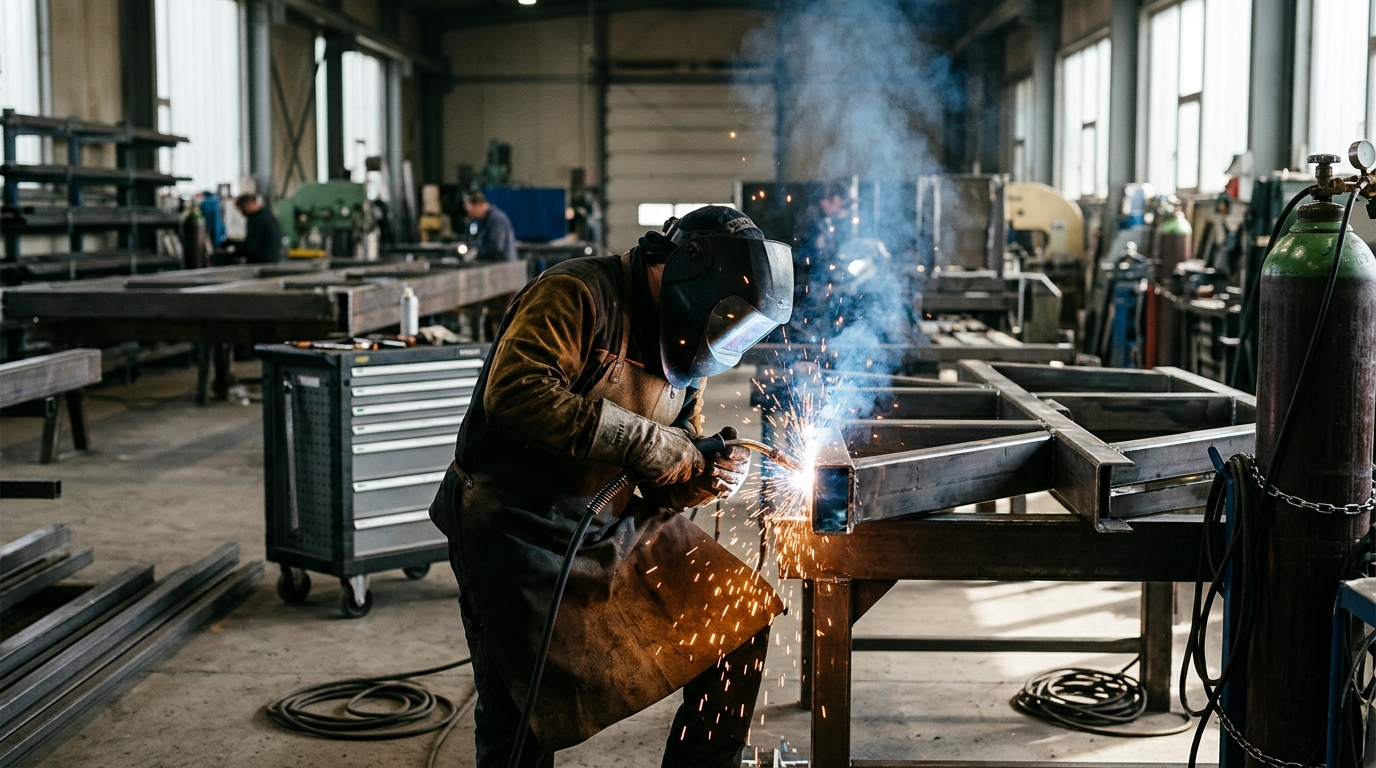
Welding is a hands-on trade you can usually enter with a high school diploma or equivalent plus technical training, and employers typically add on-the-job training after you are hired (U.S. Bureau of Labor Statistics, 2025). Training is available through high school programs, vocational-technical institutes, community colleges, private welding schools, and the U.S. Armed Forces, and some people start through an employer-based apprenticeship open to those with no prior experience (U.S. Bureau of Labor Statistics, 2025).
The fastest realistic routes run from a few months to around two years, depending on whether you take a short certificate, an associate degree, or an apprenticeship. Licensing is not universal: welders must be licensed in some states and localities, and the requirements vary (U.S. Bureau of Labor Statistics, 2025).
What the Job Involves Day to Day
Most shifts start with paperwork and setup rather than sparks. You read the work order and the drawing, check the weld symbols to see which process, joint type and position the job calls for, then pull the right filler metal and electrodes.
Next comes equipment and safety. You inspect leads, ground clamps, gas hoses and regulators, check your hood and lens, set voltage, amperage and wire feed speed for the thickness in front of you, and confirm ventilation or fume extraction is working.
Then you fit and weld. That usually means squaring and clamping the parts, tacking them, checking for gaps and distortion, and running the weld out — sometimes flat on a bench, sometimes overhead, in a trench, or on a ladder. Between passes you chip slag, wire-brush and grind.
Inspection is part of the task, not an afterthought. You look your own work over for porosity, undercut, incomplete fusion and burn-through, repair what fails, and mark or log completed joints so a supervisor or inspector can check them.
End of shift is cleanup: coiling leads, shutting down gas, storing rods, sweeping the bay, and flagging any machine problem for maintenance. Core tasks for the occupation are catalogued by O*NET OnLine, and the day shifts with the employer — production shops repeat the same joint for hours, while construction and repair work changes with each job.
Skills and Traits That Help You Succeed
- Manual dexterity — the U.S. Bureau of Labor Statistics (2025) names it for the occupation, and it shows up when you hold a steady arc length and travel speed with a stick electrode in an overhead position for minutes at a time.
- Spatial-orientation skills — also named by the U.S. Bureau of Labor Statistics (2025); you need it to turn a flat isometric pipe drawing into a real joint and to picture how a fitting sits before you tack it.
- Detail orientation — catching undercut, porosity or a missed pass yourself, before an inspector rejects the joint and you have to grind it out and run it again.
- Physical stamina and physical strength — both named by the U.S. Bureau of Labor Statistics (2025), and both relevant when you are moving gas cylinders, lifting plate, and kneeling or crouching through a long weld-out.
- Process proficiency (learnable) — hands-on competence in SMAW (stick), GMAW (MIG), FCAW (flux-cored) and GTAW (TIG), so you can take a thin-gauge stainless job and a heavy structural job in the same week.
- Blueprint and weld symbol reading (learnable) — decoding fillet versus groove symbols, leg size and field-weld flags on a shop drawing so you weld what the engineer specified.
- Cutting and finishing tools (learnable) — oxy-fuel torch, plasma cutter, angle grinder and chipping hammer, used for prep and cleanup on almost every job.
O*NET OnLine also describes personality traits associated with success in this work, which lean toward practical, hands-on preferences and working directly with tools, machines and materials.
How to Break Into This Career
- Finish a high school diploma or equivalent (timing varies). This is the typical entry-level education for welders, cutters, solderers and brazers (U.S. Bureau of Labor Statistics, 2025). If your high school runs a welding or metals program, that counts as technical training (U.S. Bureau of Labor Statistics, 2025).
- Take a short intro welding course before you commit (about 6 to 12 weeks, often evenings). Community colleges and vocational-technical institutes commonly run introductory stick or MIG classes. Use it to find out whether you can tolerate the heat, the hood and the positions.
- Pick a full training route (roughly 6 to 24 months). Technical training is available through high school programs, vocational-technical institutes, community colleges, private welding schools, and the U.S. Armed Forces (U.S. Bureau of Labor Statistics, 2025). Certificates typically run under a year; an associate of applied science usually runs about two years.
- Complete OSHA-required electrical safety training (short course, days rather than months). OSHA requires welders to complete training on electrical safety (U.S. Bureau of Labor Statistics, 2025); many programs build this in alongside PPE, fume and hot-work practice.
- Test for the AWS Certified Welder (CW) credential (a test day, after enough bench time). There are no prerequisite courses or certifications; eligibility is based on passing a performance-based test at an AWS Accredited Testing Facility (American Welding Society). Expect to practice the specific test coupon and position first.
- Apply for entry-level work or an apprenticeship (weeks to a few months of searching). Realistic first titles include welder helper, fitter helper, production welder and apprentice welder; some entry-level workers start through an employer-based apprenticeship, including ones open to people with no prior experience or training (U.S. Bureau of Labor Statistics, 2025). Before you apply, contact your state or local licensing agency — welders must be licensed in some states and localities, and requirements vary (U.S. Bureau of Labor Statistics, 2025). Expect further on-the-job training after hire (U.S. Bureau of Labor Statistics, 2025).
Typical Timeline From Start to First Job
These milestones follow the six steps above in the same order. Treat the ranges as planning estimates — program calendars differ by school, state and whether you attend full time.
- Month 0 — diploma or equivalent in hand. The typical entry-level education for the occupation (U.S. Bureau of Labor Statistics, 2025).
- Months 1 to 3 — finish an introductory welding course. Roughly 6 to 12 weeks, often part time, to confirm the work suits you.
- Months 3 to 15 (or to month 27 for an associate degree) — complete technical training at a vocational-technical institute, community college, private welding school, or through the U.S. Armed Forces (U.S. Bureau of Labor Statistics, 2025).
- During training — complete OSHA electrical safety training, which OSHA requires of welders (U.S. Bureau of Labor Statistics, 2025).
- Near the end of training — sit the AWS Certified Welder performance test at an AWS Accredited Testing Facility (American Welding Society), plus any state or local license your area requires (U.S. Bureau of Labor Statistics, 2025).
- Months 12 to 20 — first paycheck as a welder helper, production welder or apprentice welder, with on-the-job training continuing after hire (U.S. Bureau of Labor Statistics, 2025).
Apprenticeship route: if you are hired into an employer-based apprenticeship that accepts no prior experience (U.S. Bureau of Labor Statistics, 2025), the paycheck comes first and the training runs alongside it over several years.
Salary and Outlook Snapshot
Pay for welders is usually hourly, with overtime, shift differentials and per-diem common on construction and travel jobs; some production shops add output or quality bonuses. Figures move year to year and vary sharply by state, industry and whether the work is shop-based or field-based, so check the current published numbers before you make a decision.
| Measure | What it covers | Source and year |
|---|---|---|
| Entry-level pay | The lowest-paid 10 percent of welders, cutters, solderers and brazers earned less than the published figure | U.S. Bureau of Labor Statistics, 2025 |
| Median pay | Median annual wage for the occupation nationally | U.S. Bureau of Labor Statistics, 2025 |
| Experienced pay | The highest-paid 10 percent earned more than the published figure | U.S. Bureau of Labor Statistics, 2025 |
| Pay in a top industry | Median wage in specialty trade contractors, one of the top employing industries | U.S. Bureau of Labor Statistics, 2025 |
| Employment size | Number of jobs held nationally in the occupation | U.S. Bureau of Labor Statistics, 2025 |
| Job growth | Projected employment growth, 2025 to 2035, described as slower than average | U.S. Bureau of Labor Statistics, 2025 |
| Annual openings | Average annual openings projected over the decade, mostly from replacement needs | U.S. Bureau of Labor Statistics, 2025 |
Read the growth and openings rows together. Growth is slower than average, but openings are projected each year mostly because workers retire or move to other occupations (U.S. Bureau of Labor Statistics, 2025) — so hiring tends to depend on local industry and turnover rather than on rapid expansion. Look up your own state and metro figures in the Bureau of Labor Statistics Occupational Employment and Wage Statistics data before you choose a program.
Frequently asked questions
Do I need a college degree to become a welder?
No. The typical entry-level education is a high school diploma or equivalent combined with technical and on-the-job training (U.S. Bureau of Labor Statistics, 2025). A certificate program of roughly 6 to 12 months is a common route; an associate of applied science takes about two years and is optional.
Do welders need a license?
It depends where you work. Welders must be licensed in some states and localities, and requirements vary — contact your individual state or local licensing agency before you apply (U.S. Bureau of Labor Statistics, 2025). Separately, OSHA requires welders to complete training on electrical safety.
What does the AWS Certified Welder credential require?
No prerequisite courses or certifications. Eligibility is based on passing a performance-based test at an AWS Accredited Testing Facility (American Welding Society), so you are judged on the weld you produce rather than on classroom hours.
How much does welding training cost?
Costs vary by provider and state, so ask each school for its current tuition, tool list and testing fees. Lower-cost routes exist: high school welding programs, community colleges, and training through the U.S. Armed Forces (U.S. Bureau of Labor Statistics, 2025).
Can I move into welding inspection later?
Yes. The American Welding Society publishes a minimum qualification path to Certified Welding Inspector (CWI) for candidates holding only a high school diploma, based on documented work experience, and all CWI candidates must also pass a vision test.
Sources
- U.S. Bureau of Labor Statistics — Welders, Cutters, Solderers, and Brazers : Occupational Outlook Handbook (2025)
- O*NET OnLine (via My Next Move) — Welders, Cutters, Solderers, & Brazers at My Next Move