Bank Teller Career Path: Education, Steps, and Timeline
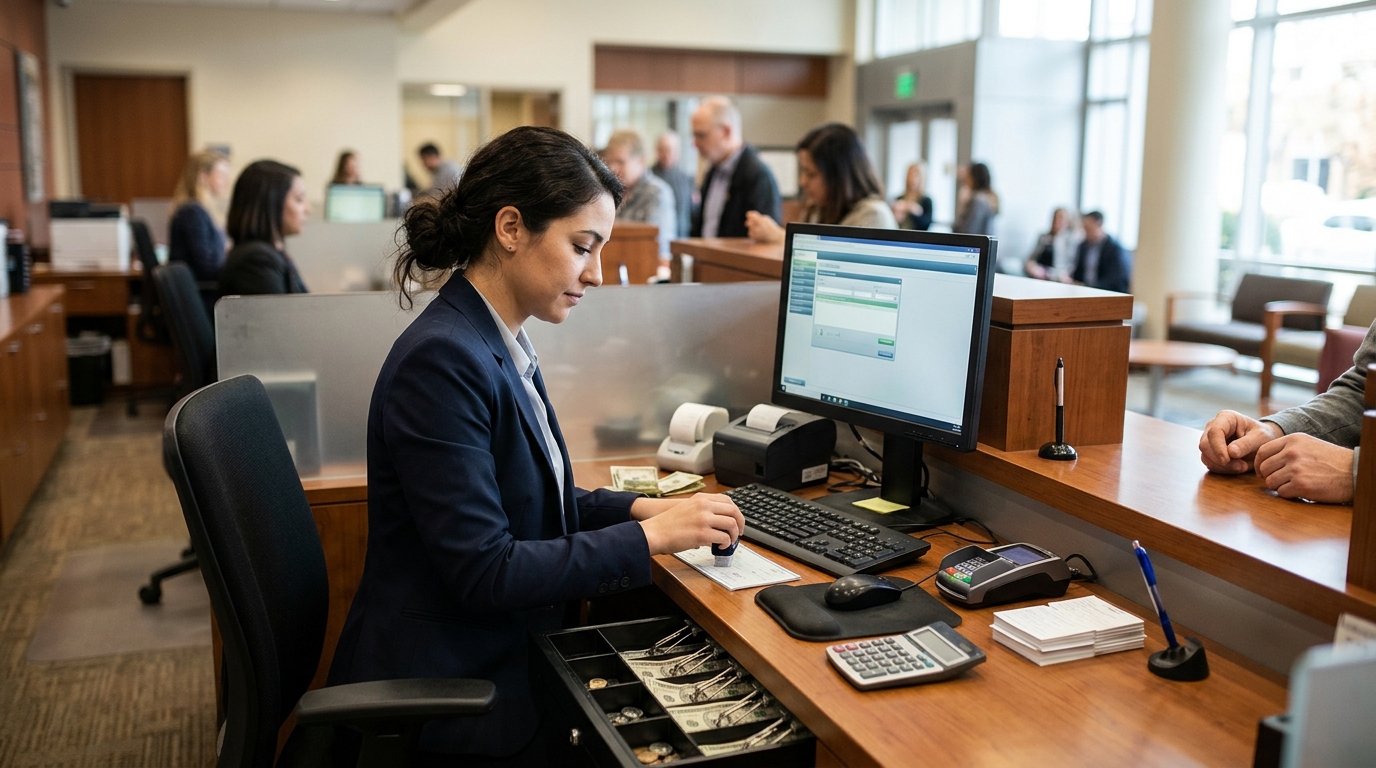
A teller's day runs on cash drawers, deposit slips and transaction screens, and most people enter with a diploma plus a few weeks of branch training.
Becoming a bank teller is one of the shorter entry routes in financial services: most tellers hold a high school diploma and receive about one month of on-the-job training, and banks commonly run a background check before hiring (CareerOneStop, undated). ONET places the occupation in Job Zone 1-2, "Very Little to Some Preparation Needed" (ONET OnLine, undated).
Optional credentials exist if you want an edge or a path toward supervisory work, including the ABA Bank Teller Certificate and the Certified Bank Teller (CBT) designation, which requires at least six months of experience in the field (bestaccreditedcolleges.org, undated).
What the Job Involves Day to Day
You start a shift by counting the cash in your drawer, then spend the day processing routine transactions: cashing checks, taking deposits, and collecting loan payments (U.S. Bureau of Labor Statistics, 2025). Across a typical week you also accept checks, cash and other payments, prepare specialized funds such as traveler's checks and money orders, exchange dollars for foreign currency, and record every transaction electronically (U.S. Bureau of Labor Statistics, 2025).
Other recurring duties include balancing currency, coin and checks in your drawer at the end of each shift, counting currency and coins for deposit or shipment, processing term deposits, retirement savings contributions, ATM transactions and night and mail deposits, ordering a cash supply, and receiving mortgage, loan and utility bill payments (O*NET OnLine, undated).
Most tellers work inside bank branches, standing or seated at a teller window behind a locked drawer, and most work full time, though part-time schedules are not uncommon (U.S. Bureau of Labor Statistics, 2025; CareerOneStop, undated).
Path to Becoming a Bank Teller
- Finish high school or an equivalency. A high school diploma is the typical entry-level education, and most tellers hold one (U.S. Bureau of Labor Statistics, 2025; CareerOneStop, undated). Some teller training programs accept enrollment in a HiSET completion program instead (University of Central Missouri, undated).
- Build basic math and keyboard skills. Program prerequisites are commonly basic-to-intermediate computer and typing skills plus basic math, and you need to be 18 or older (University of Central Missouri, undated). Practice counting cash by hand and by strap, and work on ten-key entry speed.
- Decide whether you want pre-hire training. You can apply straight to branches, or complete a short program first. CareerOneStop's Local Training Finder lists teller-related options in Texas ranging from a certificate of 12 weeks to less than 1 year, up to a bachelor's degree usually taking 4 years (CareerOneStop, undated).
- Consider the ABA Bank Teller Certificate. Delivered through AIB, it requires eight courses covering banking today, workplace conduct, ethics, relationship selling, customer service and teller basics, usually about 21 hours of study, with one year after enrolling to finish (bestaccreditedcolleges.org, undated). It is sold at a Member Price and a Non-Member Price and gives one year of access from purchase (American Bankers Association, undated).
- Apply to branches and clear the background check. Banks may run a background check before hiring, so gather identification documents early (CareerOneStop, undated).
- Complete on-the-job training. Expect roughly one month of supervised branch training on drawer balancing, deposit and withdrawal processing, check cashing and settlements before you run a window alone (CareerOneStop, undated; American Bankers Association, undated).
- Log six months of experience, then pursue certification. Certified Bank Teller (CBT) eligibility through the ABA/Institute of Certified Bankers requires at least six months of work experience in the field, one professional reference, an ethics statement, an application, a fee and completion of the AIB Bank Teller Certificate program (bestaccreditedcolleges.org, undated).
- Sit the CBT exam. It is 75 multiple-choice questions on banking fundamentals, teller duties and customer service, and requires a letter of recommendation from a senior manager (Learn.org, undated).
Timeline at a Glance
| Stage | Milestone |
|---|---|
| Before you apply | High school diploma or equivalent in hand; basic math and typing practice done (U.S. Bureau of Labor Statistics, 2025) |
| Weeks 1-4 of applying | Branch applications submitted; background check completed if the bank runs one (CareerOneStop, undated) |
| Month 1 on the job | About one month of on-the-job training on cash handling, deposits, withdrawals, check cashing and settlements (CareerOneStop, undated) |
| Months 2-6 | Running your own drawer, balancing at shift end, ordering cash supply and processing ATM, night and mail deposits (O*NET OnLine, undated) |
| Month 6 onward | Minimum experience met for Certified Bank Teller eligibility (bestaccreditedcolleges.org, undated) |
| Optional, any time | ABA Bank Teller Certificate: eight courses, about 21 hours, one year of access (American Bankers Association, undated; bestaccreditedcolleges.org, undated) |
| Optional, 12 weeks to 4 years | College certificate, associate degree (usually 2 years) or bachelor's degree (usually 4 years) (CareerOneStop, undated) |
Requirements Checklist
- High school diploma, equivalency, or enrollment in a HiSET completion program if your training provider allows it (University of Central Missouri, undated).
- Age 18 or older, where the training program or employer sets that minimum (University of Central Missouri, undated).
- Basic-to-intermediate computer and typing skills and basic math skills, demonstrable in a skills test (University of Central Missouri, undated).
- Identification and employment documents ready for a pre-hire background check (CareerOneStop, undated).
- Completed on-the-job or pre-hire training in cash handling, deposit and withdrawal processing, check cashing and settlements (American Bankers Association, undated).
- For the Certified Bank Teller designation: at least six months of work experience in the field, logged and verifiable (bestaccreditedcolleges.org, undated).
- For the Certified Bank Teller designation: one professional reference or a letter of recommendation from a senior manager, a signed ethics statement, a submitted application and the fee (bestaccreditedcolleges.org, undated; Learn.org, undated).
- Completion of the AIB Bank Teller Certificate program, which meets the pre-certification education requirement for CBT through the Institute of Certified Bankers (American Bankers Association, 2009).
Education and Cost Comparison
Pay for tellers is usually an hourly wage, sometimes with branch or referral incentives. The U.S. Bureau of Labor Statistics published a median annual wage for tellers for May 2025, along with figures for the lowest 10 percent and highest 10 percent; check the BLS Occupational Outlook Handbook and your state's labor market information site for current rates in your area (U.S. Bureau of Labor Statistics, 2025).
| Route | Typical duration | Cost structure | Where to check pay |
|---|---|---|---|
| Hire straight in with a diploma plus on-the-job training | About 1 month of training after hire (CareerOneStop, undated) | Paid by the employer; no tuition | BLS May 2025 teller wage data (U.S. Bureau of Labor Statistics, 2025) |
| ABA Bank Teller Certificate (via AIB) | Eight courses, about 21 hours, one year of access from purchase (bestaccreditedcolleges.org, undated; American Bankers Association, undated) | Member Price or Non-Member Price listed by the ABA (American Bankers Association, undated) | BLS May 2025 teller wage data (U.S. Bureau of Labor Statistics, 2025) |
| ICBA Teller Specialist Certificate | Online learning across four areas: teller basics, customer service, checks and compliance (Indeed citing Independent Community Bankers of America, undated) | Published by the issuing association | BLS May 2025 teller wage data (U.S. Bureau of Labor Statistics, 2025) |
| College certificate | 12 weeks to less than 1 year, or 1 to less than 2 years (CareerOneStop, undated) | Community college tuition, varies by state and district | State labor market information office |
| Associate or bachelor's degree | Usually 2 years, or usually 4 years (CareerOneStop, undated) | College tuition, varies by institution | State labor market information office |
The practical contrast: the diploma-plus-training route puts you behind a window in roughly one month, while a bachelor's degree route takes about four years before you start (CareerOneStop, undated).
Frequently asked questions
Do I need a college degree to work as a bank teller?
No. The typical entry-level education is a high school diploma, and most tellers hold one (U.S. Bureau of Labor Statistics, 2025; CareerOneStop, undated). O*NET surveyed respondents on the education employers want in new teller hires and reports the share at each level, which is worth reviewing on the O*NET Tellers page before you rule out a degree (O*NET OnLine, undated).
How long is teller training once a bank hires me?
Plan on about one month of on-the-job training, covering cash handling, deposit and withdrawal processing, check cashing and settlements (CareerOneStop, undated; American Bankers Association, undated). Banks may also require a background check before your start date, so build that into your timeline (CareerOneStop, undated).
Is the Certified Bank Teller designation worth doing before I apply?
You cannot do it first. CBT eligibility requires at least six months of previous work experience in the field, a professional reference, an ethics statement, an application and fee, plus completion of the AIB Bank Teller Certificate program (bestaccreditedcolleges.org, undated). The exam itself is 75 multiple-choice questions on banking fundamentals, teller duties and customer service (Learn.org, undated).
Are teller jobs shrinking?
The U.S. Bureau of Labor Statistics publishes both the current number of teller jobs and a projected outlook for 2025-35 in the Occupational Outlook Handbook, and that is the figure to read before committing (U.S. Bureau of Labor Statistics, 2025). Because most tellers work in bank branches, local branch openings and closures in your metro area matter as much as the national number (U.S. Bureau of Labor Statistics, 2025).
Can I work part time as a teller?
Most tellers work full time, but part-time work is not uncommon, which makes the role workable alongside study (U.S. Bureau of Labor Statistics, 2025; CareerOneStop, undated). Ask at interview how shifts are scheduled, since branch opening hours and Saturday coverage drive the rota.
Sources
- U.S. Bureau of Labor Statistics — Tellers : Occupational Outlook Handbook (2025)
- O*NET OnLine (U.S. Dept. of Labor, Employment and Training Administration) — 43-3071.00 - Tellers